How Europe is moving on without the US
I recently returned from Europe, where I spent eight days speaking with business leaders, senior government officials and journalists across Germany, Italy and the United Kingdom. The picture on the ground is worse than America understands. The erosion of US credibility has moved past frustration and into structural realignment. Allied governments are no longer reacting to the Trump administration. They are building around it.
The International Energy Agency has called the Strait of Hormuz blockade the largest supply disruption in the history of the global oil market. Right now, nearly 2,000 ships are stranded on both sides of the strait. Only 292 commercial vessels transited by the end of March, which is roughly 95% below pre-war levels. Oil has surged from $72 a barrel before the war to – at its peak – $118. War-risk insurance premiums have quadrupled, adding a quarter of a million dollars per crossing for a single large tanker. Iran is now attempting to charge vessels approximately $2 million for safe passage, effectively converting a critical international waterway into a toll booth and demanding semi-sovereign control over it as a condition for ending the war.
All of this was avoidable. None of it had to happen.
As is the case in America, working class folks in Europe are paying the economic price for the administration’s nonsensical policies. Germany and Italy both face technical recession by year’s end if the blockade persists. UK inflation is expected to breach 5%. Chemical and steel manufacturers across Europe have imposed surcharges of up to 30%. The Philippines declared a state of emergency. Countries from Pakistan to Nigeria to Zimbabwe are rationing fuel. Layer the trade war on top of this and you have a compounding crisis in which the American president is simultaneously raising the cost of European goods through tariffs and raising the cost of European energy – all the while demanding incessantly that they spend much more for their own defense
Much of that burden will be carried by the working class.
There is also a humanitarian dimension to this that cannot go unsaid. American service members have been killed. Civilian casualties across the region are mounting. You have significant population displacement and critical infrastructure loss. The United States once derived moral authority from its commitment to international law and the protection of civilian life. We were once the Shining City on the Hill: despite the inevitable accusations of causing “collateral damage” and adopting various double standards when using deadly force, the overall posture was based on a presumption and an active effort to project moral authority
That authority is eroding in real time.
According to YouGov’s March 2026 tracker, only 10% of Germans now view the American president favorably. In France it is 14%. In the UK, 14%. Italy, 12%. Spain, 15%. In Denmark it is as low as 3%. Only 25% of Europeans now consider the United States a friendly country, down from 61% in October 2024.
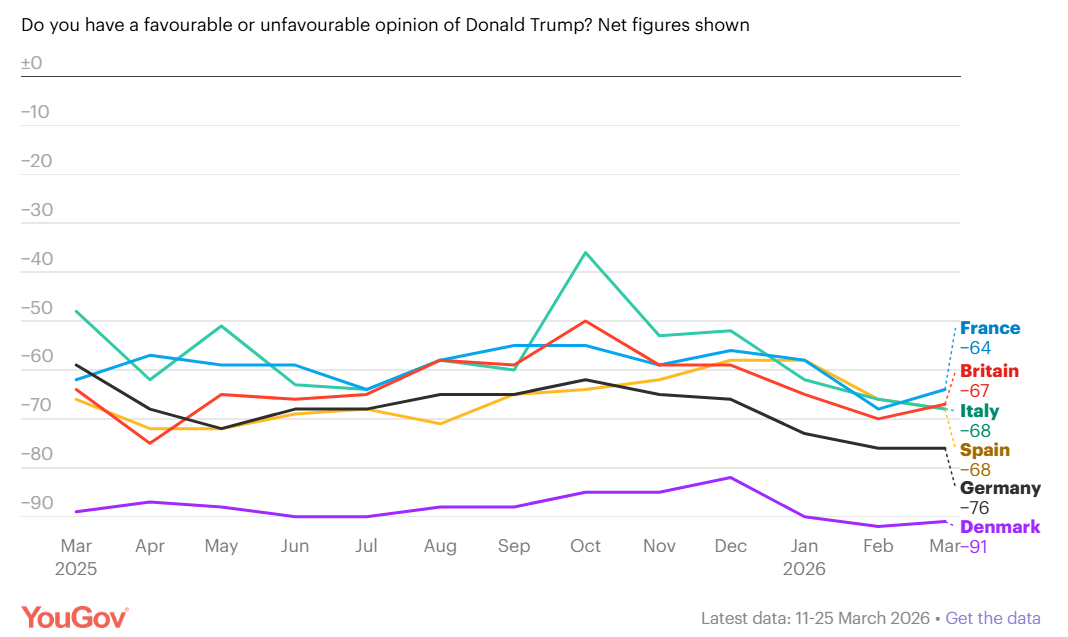
The US now ranks third from last among nations Europeans consider friends, ahead of only Russia and Iran.
There is a calcified antipathy forming toward the United States that will not thaw with a new administration. The Western alliance that has generally provided economic prosperity, peace and stability over generations is collapsing. It took decades to build and barely one year of a second Trump presidency to destroy.
The sentiment I heard from leaders across three countries was expected but jarring, nonetheless. It is clear to me that an aggressive shift toward China and away from the United States is happening as you read this. Our friends and allies no longer see us as a beacon of stability and reliability. As with the breach of most relationships, this erosion is not simply because of one issue or another, but more about a cavalcade of irresponsible, irrational and sometimes illegal behavior by the Trump administration.
Read also: How the US-Israeli war on Iran is making the world more multipolar
Interestingly enough, none of the people I met with were surprised by Trump’s flummoxing behavior but they all asked for clarity on one issue: where is Congress? They did not understand how one man in our government could simply destroy the global order without any institutional guardrails. It is a question my 77 year old mother asks me at least once a week when she turns on her local news and learns of the newest outrage waged by this administration.
As many of you know, herein lies the dissonance between rhetoric and reality.
Article I of the Constitution vests the power to declare war in Congress. It vests the power to regulate commerce with foreign nations in Congress. It vests the power of the purse in Congress. The Republican majority has surrendered all three. The president is waging an undeclared war with no explicit Congressional approval based on specific war aims, rewriting trade policy by executive fiat and requesting $200 billion in supplemental funding while the Speaker of the House and Senate Majority Leader send members home on vacation.
History will judge Donald Trump. But it will be equally unforgiving toward a Republican majority that stood by as he profited billions from the presidency, waged a trade war without constitutional authority and dismantled the very systems that made America the gold standard of democratic governance.
I get the feeling that our European friends are judging us this very same way in this moment.
That is problematic, but the economic consequences of these reckless decisions deserve equal alarm. While nearly 8 million Americans remain unemployed, while credit card and consumer debt reach their highest levels ever at $1.3 trillion and $18.8 trillion and while prices for food and gas continue to climb, Donald Trump’s decisions may just make those issues worse.
The transatlantic economic relationship is not an abstraction. It is the single largest commercial artery in the global economy. Total US trade in goods and services with Europe exceeds $2 trillion annually. European foreign direct investment in the United States stands at $3.5 trillion, while American investment in Europe reaches $4 trillion. Taken together, US exports to the European Union support 2.3 million American jobs, and European firms operating on American soil directly employ another 3.4 million workers. When the full breadth of supply chain dependencies is accounted for, trade with the EU alone sustains more than six million American livelihoods. This is not a peripheral economic relationship. It is the foundation upon which postwar American prosperity was built and the architecture through which American goods, services and influence flow into the world’s most lucrative consumer markets.
Trump’s trade war and his unilateral military escalation in Iran are now threatening that foundation simultaneously. The $200 billion in supplemental war funding the president has requested will compound the very debt burden already crushing American households.
Read also: The Price of Access to the US market
When the president imposed sweeping tariffs on allied nations and then publicly branded NATO partners as “cowards” for declining to assist in reopening the Strait of Hormuz, he did not merely fracture a diplomatic relationship. He gave European capitals precisely the justification they needed to accelerate an economic realignment that had been building quietly for months. Brussels is now fast-tracking trade agreements with Mercosur, India, Japan, Canada and South Korea. In February the European Commission moved to provisionally implement the EU-Mercosur agreement, which would create the largest free trading area on earth. That is an explicit effort to reduce commercial dependence on the United States. The European Union is not threatening to diversify. It is diversifying. And every new trade corridor that Brussels opens with a partner that is not Washington is a corridor that American exporters, manufacturers and workers may never recover.
The strategic miscalculation here is breathtaking in its scope. A trade war requires leverage, and leverage requires that your adversary has no viable alternative. But Europe has alternatives and Trump, through diplomatic recklessness and military overreach, has given allied governments the domestic political cover to pursue them. The result is an emerging global trade architecture that is being redesigned, in real time, to route around the United States. The six million American jobs sustained by transatlantic commerce are not guaranteed by geography or tradition. They are sustained by trust, by institutional stability and by the perception that the United States is a reliable partner. All three are now in open question.
Right now, Europeans are building energy, trade and security architectures that do not require American participation. Every month this continues, the reversibility diminishes. I still assured them the partnership will endure economically, militarily and socially, and many others agree with this assessment across the US. And I meant it. But credibility requires more than conviction. It requires a functioning Congress.
A Democratic House under Hakeem Jeffries – with his experience as House minority leader – would reassert the constitutional oversight this Republican majority has refused to exercise, holding this president accountable for unauthorized wars, personal enrichment from public office and the erosion of alliances that generations of American leadership built. The tools of correction are not broken. They are waiting to be used. Our allies heard that message. Whether they are prepared to wait for it is the question that should keep us up at night.