Pope Leo XIV, American Catholicism and international politics
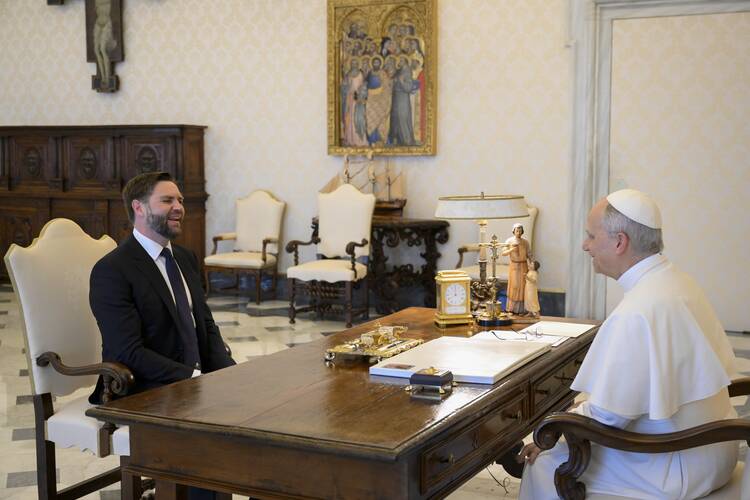
US Vice President and American Catholic J.D. Vance sat down for an interview with New York Times columnist Ross Douthat at the US Embassy to the Holy See in Rome last May.
Douthat: So we’re here in Rome, the day after the papal inauguration, and you just met with Pope Leo XIV, the first American pope.
Vance: I did.
Douthat: So what did you talk about?
Vance: Well, I want to be respectful of the private conversation we had.
Generally, we talked about issues the Vatican cares a lot about. Obviously, they care about the migration issue. They care a lot about world peace. They care a lot about what’s happening in Russia and Ukraine. They care a lot about what’s happening with Gaza and Israel. It was a very productive conversation. I mean, amazing to me. As you know, I was one of the last world leaders to meet with Pope Francis on Easter Sunday, before he passed away. I’m actually wearing the tie that he gave me, which is very cool.
Vance is as good an entry point as any for a reflection on the current state of Catholics and politics in the United States and what we might expect will become of Pope Leo’s relationship with them. While he is the most important Catholic in elected office in the US today (more on that in a minute), Vance is certainly not representative of the whole of American Catholicism. But who could be?
American Catholicism has always been distinguished by a teeming diversity that has evolved alongside social, cultural and political change in the country. Catholics who fill the pews on any given Sunday, in mixed and not-so-mixed parishes across cities, exurbs and rural counties, could be recent migrants from Venezuela, Brazil, the Philippines, Vietnam or the DRC; or they might be third or fourth or fifth generation combinations of Irish, Italian, Cuban, Polish or Mexican Americans; or Americans who have forgotten their distant origins altogether. Some worship as charismatics; some mix Pentecostalism in with their devotions; some are tied to the Latin mass; or Eucharistic Adoration; others still like their folk music; many liturgies are prayed in Spanish; and lots more are boring and plain with pretty bad music and lots of donuts.
Within American politics, the socio-economic diversity that this global mix represents makes the Catholic vote look a lot like the US population as a whole. As opposed to the more or less consolidated voting blocs of Evangelicals, Mormons, Jews, or non-Religious, Catholics are split between the two parties, and they have consistently voted with slim to modest majorities for the Presidential winner for decades, including for Reagan, Clinton, G.W. Bush, Obama, Trump, Biden (according to some polls) and Trump again. The public policy interests of the US Conference of Catholic Bishops do not fully correspond, therefore, to either the Republican or Democratic party platform: they have been consistently against abortion and welcoming of migrants.
At the same time, important shifts in American Catholicism are underway and they have been especially noticeable at the level of elite Catholic politics and intellectual debates, both of which have influenced some of the ideological positions animating the ascendant Republican right. Vance, in particular, has close ties to post-liberal Catholic intellectual circles, including Patrick Deneen of the University of Notre Dame, and Sohrab Ahmari of Compact Magazine. As the title of Deneen’s bestselling book makes clear, the post-Liberals view the project of liberalism as having failed today, and they see that failure as the result of the long run decline of liberal nations’ Christian moral foundations, upon which liberal societies simultaneously rely (especially for social solidarity), but which they also destroy from within.
This diagnosis helps explain the culture war mentality which has gripped the Trump administration, perhaps most evidently seen in their attack on institutions of higher education like Harvard University. Like liberalism as a whole, many post-Liberals perceive Universities to be bad faith actors who have instrumentalized academic freedom and principles of neutrality to marginalize Christian moral values from the public sphere, greatly damaging the fiber of American society in the process. Obama-era policies which sought to enforce progressive social changes and judicial victories, in part, helped to feed some of these perceptions, which would then successively grow in response to the “peak woke politics” of the covid-era.
Read also: The Holy See’s paramount role: moral leadership in times of social unravelling
The post-liberal logic extends to the sphere of international politics and institutions, which are viewed with similar suspicion and ill-intent. In response, American post-Liberals have supported more openly Christian and nationalist politics which are clear about protecting the identity of the United States as a Christian nation, as well as the moral foundations which spring from that. Vance’s hostility to European free speech laws, security policies and trade can be read in this light: not only is Europe seen as an ungrateful freeloader – see Vance on “I just hate bailing out Europe again,” – like Harvard, it is viewed as a cipher for (a failed and hostile) liberal culture and politics. The Trump administration’s attacks on the liberal international system, therefore, arise in part from these ideological and cultural positions.
So what does all of this mean for Pope Leo XIV, the first American (i.e. US-born) Pope?
One of the most important things about Pope Leo is that he stands outside of the American and global culture wars. He also appears to stand largely outside of the US Catholic Bishops Conference, which has been deeply affected by political and social polarization in the United States. Leo became a parish priest in Peru in the 1980s, long before the post-liberal turn, when the US Catholic hierarchy was more optimistic about its dealings with liberalism, and he has spent his career listening to the hopes and fears of the global Catholic Church.
As Pope, Leo will be required to engage the US Church, and perhaps directly with Vice-President Vance, not primarily because he is an American Pope, but because the fate of American Catholicism is important for the future of global Catholicism and the future of the international order within which it operates. As indicated above, the order we have inherited from the late 20th century – the liberal international system – is in a dangerous phase of transition, rocked by violent crises, ideological challenges and the apparent withdrawal of its primary architect, the United States.
A new model of international order is not yet apparent and transnational religious traditions are being looked to for orientation as a result. It is quite possible that the College of Cardinals placed a bet on Robert Francis Prevost, as an insider-outsider, as an institutionalist, as someone devoted to the concerns of global Catholicism, waging that he was well placed to help manage this moment of transition. It is a risky bet, one that is vulnerable to getting sucked into the pathologies of US politics, but it also has important potential payoffs, especially if Leo were to succeed in mobilizing American Catholics, both those in the pews and those in politics, for the one public policy he has placed at the center of his papacy from day one, namely, international peace.
A John Paul II-Francis synthesis?
One way that this could play out would be for Pope Leo to adopt a kind of Pope John Paul II-Pope Francis synthesis in his governing style and concerns.
From the perspective of global politics, Pope John Paul II embodied the moral triumph of the liberal international order as it emerged at the end of the Cold War. In part, his public advocacy sprang from the Catholic Church’s new positions which it forged with liberal modernity in the aftermath of World War II – especially on freedom and dignity and rights. Those positions led to a wave of Catholic activism in support of democratization and human rights in authoritarian contexts across the globe, including by a young Fr. Bob Prevost in Peru in the 1980s.
In some ways, particularly in its beginnings, the papacy of Pope Francis took these foundational norms for granted and assumed that international cooperation could be constructed on a shared vision of universal dignity, freedom and rights. Francis’ public concerns, on the environment, migration, interreligious dialogue or sustainable development, might be understood in this optic as second generation rights which became clearer and pressing in part because first generation rights seemed more or less settled and secure. Francis largely avoided theological reflection on the political foundations of that order as a result and focused instead on the social and moral need for solidarity (or fraternity) to make that system work for those on the peripheries.
Read also: Assessing the Geopolitics of Pope Francis
From Vance’s quote above, it looks like Pope Leo spoke his mind to him on at least two issues which put him in direct continuity with Pope Francis, namely, international peace and migration. Leo will now have to figure out how to pursue those policies in a fragmented and contested global system. To work towards international cooperation on peace, on the environment, or on development, however, he may need to go back to the fundamentals, the basic package of dignity, freedom, democracy and rights, in order to institutionally steer and ground the Church’s international diplomacy and civil-society-level public actions. Such a back-to-the-basics approach could help clarify, motivate and bring coherence to the Church’s positions, for example, in both Gaza and Ukraine, as well as in the United States.
A John Paul II – Francis synthesis might provide a simple directional for Leo’s pontificate, namely: to pursue Francis’ global social agenda with renewed commitment to the norms guiding John Paul II’s international politics. In their own ways, both popes continued the theological and political reforms begun at Vatican II which opened the Catholic Church towards modernity in a way that Leo XIV’s namesake positively anticipates (as Leo XIII marked the dawn of Catholic social thinking and political modernity). Combining the two, therefore, could also likely suit the personality, experience and intuitions of Leo himself, whose young religious life and politics came to age in John Paul II’s pontificate.
It is worth remembering that Pope John Paul II was deeply beloved by the American Catholic Church, who felt his loving gaze upon them and who were called by him to international responsibilities and solidarities. As such, a John Paul II-Francis synthesis might also help Pope Leo’s appeal to VP Vance, and to the rest of the teemingly diverse American Catholic Church, to build local and global solidarity with those on the margins – as Prevost had previously done on behalf of Pope Francis – but also to reimagine global and democratic politics which reflect those solidarities better.
Pope Leo XIV’s motto, in Illo uno unum, rhymes in interesting ways with that ancient American ideal, e pluribus unum. Both are lofty and bold as political agendas. They also indicate the deep fractures besetting our international system today. We can only hope for Leo’s success as he pursues these unities in the name of peace.