Why Trump’s defeat is not a return to the post-Cold War “Liberal Consensus”
America’s impressive “blue wave” in the midterm elections is a welcome reminder that democracy retains the capacity to surprise, mobilize, and change course. Voters across regions and demographic groups have rebuked Donald Trump, broken Republican dominance and reopened possibilities that seemed foreclosed. For Europeans watching anxiously across the Atlantic, the temptation to celebrate a turning point is natural. But an electoral reversal for Trump does not necessarily reverse the historical forces that brought him to power.
The immediate consequences will be profound. Republicans face a reckoning, and a party civil war looks likely. Yet the outcome of this internal battle may be a restoration of MAGA rather than its repudiation: a struggle to preserve America First-ism, economic nationalism and cultural conservatism while developing a post-Trump leadership and agenda.
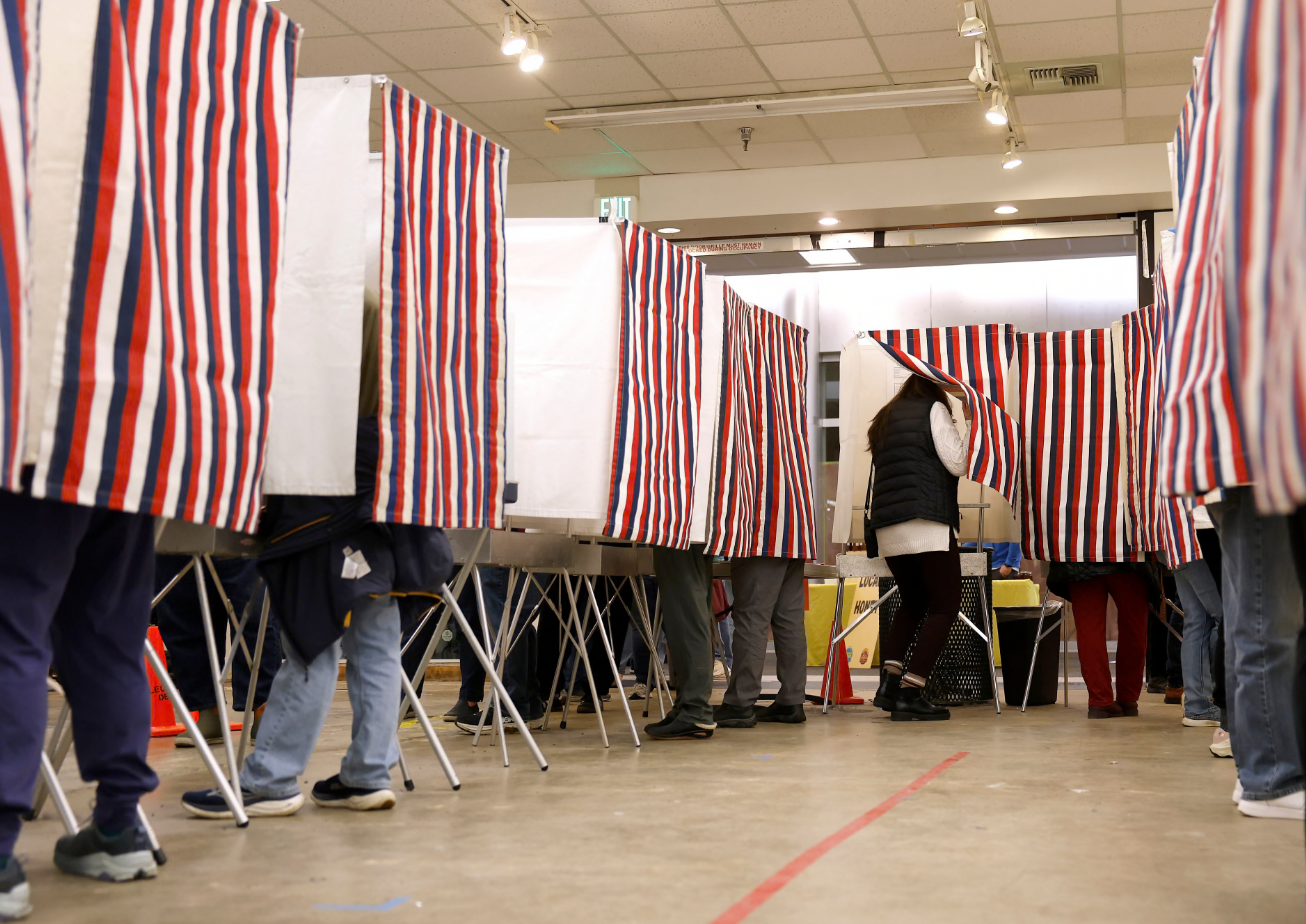
Nor the establishment’s revenge…
Equally, the blue wave should not be mistaken for an endorsement of the Democratic establishment as we have known it. Voters disappointed by Trump have also turned to other forms of populism, often without abandoning their demand for disruption. Economic nationalism promised protection, prosperity and control; disappointment with its delivery is redirecting that demand towards candidates promising to confront corporate power and broaden economic opportunity. “America First” was rooted in a generalized opposition to the foreign military entanglements of decades past; the US-Israel war against Iran has further entrenched this anti-interventionist sentiment. The revolt thus changes political direction without necessarily changing its underlying target: the “liberal consensus” that Republican internationalists and mainstream Democrats embraced in the 1990s and 2000s.
Consider Michigan, which has just elected its first Muslim senator. During the campaign, the populist left-wing candidate Abdul El-Sayed declared: “I’m not against tariffs per se. I’m just against dumb tariffs.” His Republican opponent, Mike Rogers, defended duties intended to “correct about 40 years of bad trade policy”. El-Sayed attacked USMCA (NAFTA’s successor) and advocated protection linked to industrial renewal. Although their biographies differed sharply and their political platforms were far apart on many issues, neither candidate offered a return to unquestioning faith in free trade. Both sought to reclaim political control over economic outcomes.
On the same topic:
Tre riflessioni (e mezza) sulle midterm americane
Le vie aperte dalle midterm alla Casa Bianca
The significance extends beyond that contest. Left-wing and right-wing populisms, in America as well as in Europe, are challenging orthodoxies that became mainstream since the 1990s: that globalization would broadly distribute prosperity; that economic interdependence would encourage political convergence and reduce geopolitical competition; that liberal norms and institutions were universally desired and needed to be exported, and that borders and national identities would gradually matter less. Across many constituencies, disappointment with these promises has fueled distrust of government, disillusionment with representative democracy, a desire for anti-establishment charismatic leaders, and a demand for collective protection and recognition that can often clash with individual rights and liberties.
…or the populism’s defeat
Seen in this light, the ongoing transatlantic crisis concerns more than America turning its back on Europe: it reflects a crisis of liberalism across the West. Trump is both a product and agent of that transformation. Defeating his candidates cannot restore the conditions that once made liberal internationalism appear the natural destination of political development. That confidence rested partly on Western preponderance after the Cold War. The ambition went beyond expanding markets or holding elections. International institutions would progressively constrain arbitrary power, protect smaller states alongside larger ones, and generate prosperity and political legitimacy. Universal principles would gradually “civilize” international relations, almost as though a constitution for the world – a “liberal international order” – could emerge through deeper cooperation and wider inclusion.
To be sure, the promise was never consistently honored. Western strategic support for certain authoritarian regimes in the Middle East and the invasion of Iraq, among other examples, exposed the gulf between universal aspirations and selective enforcement. Yet the distinction between betraying a principle and abandoning it matters. Today’s danger, poignantly captured by Canadian Prime Minister Mark Carney’s 2026 Davos speech, is that acknowledged hypocrisy becomes permission to discard constraints altogether.
America’s domestic turmoil belongs to this wider disorder. Leaders across the world advance their own versions of national greatness, pursuing advantage through opportunistic bargains and coercion. These projects are not identical, but they increasingly privilege immediate gains over predictable commitments. Interdependence becomes a vulnerability to exploit. Sovereignty becomes a claim to unrestricted action, while global governance is a stumbling block to be overcome. Confrontation displaces competition, and brute force regains prominence as an instrument of statecraft.
Message to Europe
Europe therefore cannot read the blue wave in the US as deliverance. Democrats remain more receptive to alliances and multilateral cooperation, including support for NATO and Ukraine’s struggle for independence. But Europe faces its own crisis of consent. France’s National Rally and Germany’s AfD continue to attract voters who feel economically insecure, culturally disregarded or politically powerless. Appeals to “European strategic autonomy” carry little weight with audiences that demand greater national control, favor less international aid, oppose efforts to export democratic values and want domestic concerns to take precedence over international commitments.
Read also: The US midterm elections and their early implications for Europe
A closer look reveals that Europe’s political and economic mainstream has itself already moved beyond important elements of liberal orthodoxy. Industrial policy, investment screening and de-risking qualify the presumption that economic openness necessarily enhances security. Migration is more tightly managed across EU countries governed by both the center-left and the center-right. Other adjustments include reconsidering approaches to integration and multiculturalism, and the costs and distributional consequences of environmental policies. These changes can strengthen democratic legitimacy and encourage political re-engagement, provided they respect fundamental rights and constitutional limits on majority rule. Correcting liberal orthodoxy need not entail abandoning liberal democracy. Europe, Canada, Australia and other partners can defend sovereignty, diversify economic relationships and sustain cooperation where global institutions struggle.
The purpose should be to protect and reform a multilateral system that delivers shared benefits and resists the supposed inevitability of conflict. Such an effort must acknowledge how much the foundations of the previous order have changed and are unlikely to return. America’s blue wave thus unfolded on a terrain profoundly transformed by the crisis of liberal orthodoxy and globalization, which Trumpism itself was already an expression of.