The quest for a new political balance in the Netherlands
For many Italians, the Netherlands is considered a paragon of political stability. The country is known for pragmatic governance, a strong economy, and a political culture in which compromise seems more important than ideological struggle. Yet, precisely that reputation has come under severe pressure in recent years.
The House of Representatives elections of October 2025 and the subsequent formation of the cabinet led by Prime Minister Rob Jetten of the left-liberal party D66 show that the Netherlands, like other European countries, is struggling with a fragmented political landscape and with the question of how to govern effectively in a time of polarization.

An evolving context
The Netherlands has a system of proportional representation. Unlike in countries with a constituency-based system, such as the UK, or a majority bonus, such as Italy, virtually every vote counts towards the distribution of the 150 seats in the Dutch House of Representatives – Tweede Kamer. Consequently, no single party can ever govern alone. Coalition governments are not the exception, but the rule.
After elections, long weeks or months of negotiations often begin between various parties to form a cabinet that can count on a parliamentary majority. For years, this system made the Netherlands relatively stable. The necessity of reaching compromises prevented major political shocks and fostered a culture of consultation and consensus.
However, over the last two decades, the Dutch party landscape has changed significantly. Large mainstream parties have lost ground, while new parties have emerged around themes such as migration, climate, agriculture, integration, animal rights, European integration, and administrative reform. The result is a parliament consisting solely of medium-sized and small parties, making it increasingly difficult to form stable coalitions.
The 2025 Elections
During the elections of October 2025, no single party achieved a convincing victory, making various potential coalitions politically difficult or even impossible. After lengthy negotiations, a minority cabinet emerged consisting of the left-liberal D66, the right-liberal VVD, and the Christian Democratic CDA, led by Rob Jetten. Together, they hold 66 seats in the 150-seat Tweede Kamer. In the Senate, they also lack a majority.
The concept of a ‘minority cabinet’ deserves a closer look. Unlike most Dutch governments, this cabinet does not possess enough seats in parliament to pass legislation independently. For virtually every legislative proposal, it must seek support from opposition parties, on either the left or the right. This makes governing fundamentally different from a classic coalition, where a fixed majority can govern stably and call the shots.
A smell of fear
The Netherlands has so-called ‘traditional governing parties’ and new, often non-establishment parties. After October, D66—a long-standing party that narrowly won the elections—was tasked with leading the formation talks. The decision was made to form a cabinet exclusively with other traditional parties. Instead of inviting new, non-establishment parties to participate in the negotiations, a centre-right minority government was quickly chosen in November.
Were there not enough traditional parties available? Certainly, there were. The three coalition parties could have teamed up with the alliance of Social Democrats and Greens (Pro), which would have provided them with a comfortable majority in both the House of Representatives and the Senate. However, this option was ruled out by the right-liberal VVD. Its leader, Dilan Yesilgöz, had promised her voters never to cooperate with Pro.
Yesilgöz’s promise ensured a surge during the final weeks of the campaign. With 22 seats, the right-wing liberals remained large enough to participate in government—a long-standing goal of former Prime Minister Mark Rutte’s party.
At the same time, the progressive liberal D66 did not want to cooperate with right-wing non-establishment parties such as the farmers’ party BBB and the right-nationalist JA21. With those two, there would also have been a majority in both Houses. However, such an alliance would have been risky for D66, which feared losing voters to Pro in the next parliamentary elections. Thus, largely because both liberal parties feared the electoral consequences, a minority variant was selected as ‘the best outcome’.
Old-fashioned governing
On paper, a minority government does not have to be a problem. Scandinavian countries, which regularly run successful minority cabinets, are a good example. In the Nordic region and elsewhere, success depends on how such a cabinet cooperates with parliament. And this is precisely where the Dutch government seems to be running into its biggest problems.
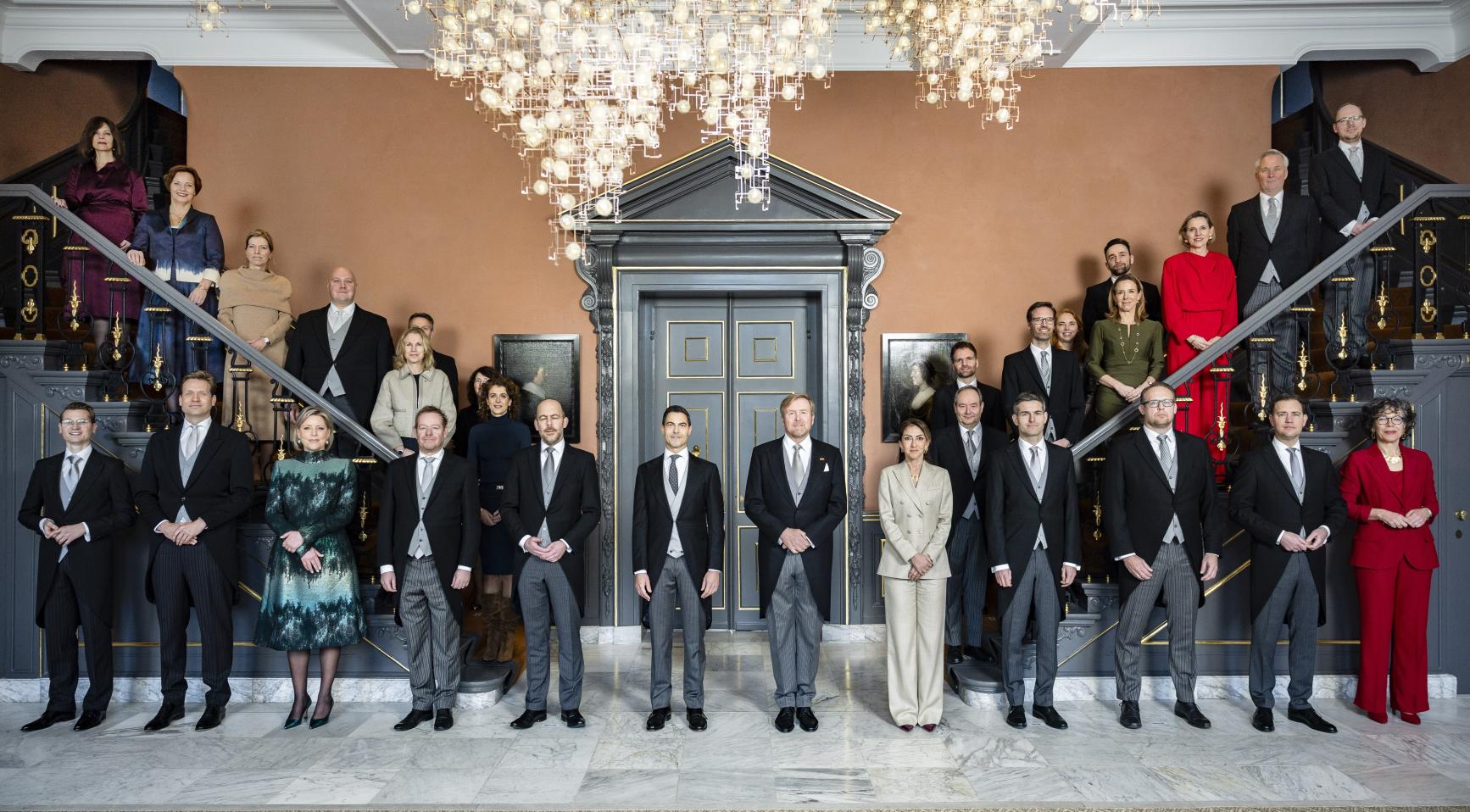
The central question is not why the Jetten cabinet is struggling to find majorities—which has been the case since its inauguration by King Willem-Alexander—making the early days of this cabinet entirely predictable. It is more interesting to examine why the search for majorities is proceeding so laboriously.
According to some, the primary reason lies not in the fragmentation of parliament, but rather in the coalition’s governing style. Although the cabinet is formally a minority government, it often operates as if it were a regular majority coalition. The three governing parties first negotiate a compromise amongst themselves and then present it to the rest of parliament, assuming they will find support for it.
The Dutch paradox
This creates a paradox: it leaves little room for opposition parties to exert substantial influence on policy. Politically speaking, this approach is unappealing. Why would an opposition party take responsibility for policy to which it has barely been able to contribute or have a meaningful say in? This can be considered the most significant structural weakness of the Jetten cabinet.
How does this translate into political practice?
Under pressure from the right-liberal VVD, the Jetten cabinet has initiated a policy of austerity and spending cuts. To meet the NATO target of 5 percent, among other priorities, major cuts are planned in healthcare and social security. Changes to the pension system are also foreseen, alongside numerous minor cutbacks intended to free up funds for defence spending.
For instance, cuts were proposed for disabled care, the duration of unemployment benefits was to be shortened, and the retirement age raised. These measures were fiercely opposed, particularly by Pro and the trade unions. To date, no major cuts or reforms have passed through parliament because no majority could be found.
Importantly, the drive to cut spending is almost automatic in the Netherlands due to tight budgetary rules self-imposed since the 1990s. Expenditures are fixed for an entire government term, and any windfall in the state treasury must be used to pay down national debt.
Consequently, there is virtually never room for extra spending. Borrowing on the markets at favourable interest rates is also a major taboo. These rigid rules foster a culture of low spending, but also a lack of vision and a general acceptance of certain risks—such as neglecting the maintenance of bridges, roads, canals, and railways. An estimated €80 billion will be needed for overdue infrastructure maintenance alone, yet this money has not been budgeted because, according to the rules, it is simply not there.
Frugal or not, frustration quickly arose among right-wing opposition parties, particularly regarding the Minister for Development Cooperation, Sjoerd Sjoerdsma (D66). His budget had initially been approved with the support of small right-wing, Christian, and conservative parties. The condition? Cutting millions in funding for UNRWA, the UN agency for Palestinian refugees.
Without consulting these right-wing parties, Sjoerdsma decided to allocate funds to UNRWA anyway, causing outrage. They withdrew their support immediately, forcing Sjoerdsma to seek backing from the left-wing Pro party, which demanded an additional €320 million for development aid in 2027 alone. This demand impacts the entire budget for this government term. Consequently, after next year, Mr. Sjoerdsma will be out of funds until the term ends in 2030.
Structural flaw
The fundamental flaw is not that a minority cabinet now governs the Netherlands. The mistake is that the cabinet is attempting to apply the political logic of a majority government to a minority structure. A true minority government does not begin with a pre-packaged coalition compromise; instead, it builds policy from the ground up through continuous consultation with multiple parliamentary partners.
An alternative would have been to negotiate during the formation phase with parties that could provide structural rather than ad-hoc support. That way, stable parliamentary backing would have been established—naturally in exchange for concessions to the constructive opposition. In Denmark and Sweden, many such government structures have proven successful over recent decades. While the model works there, it has yet to materialize here.
Political culture
For a Dutch minority government to function effectively, a shift in political culture is required. A single, fixed coalition should not take centre stage; instead, there must be an ongoing process of cooperation with various parties. In such a framework, compromises are negotiated during the parliamentary process rather than finalized before legislation is presented.
Furthermore, a comprehensive agreement with one or more key opposition parties remains absent. The Jetten cabinet seems only partially willing to shift in this direction. It has been constantly re-negotiating every vote, leading to direct consequences: virtually every major political file requires a fresh search for a majority.
At times, the cabinet seeks cooperation with progressive parties; at others, with small Christian parties or right-wing factions. Every bill requires a different combination of support, making decision-making slow and unpredictable.
What are the consequences? For citizens, it creates the image of a government perpetually locked in negotiations without clearly communicating its ultimate direction. For businesses, this style of governance introduces uncertainty regarding investments and regulations. And for foreign partners and the EU, it raises serious questions about the administrative effectiveness and reliability of the Netherlands.
Fragmentation is not the only explanation
It is tempting to attribute all Dutch political challenges to the sheer number of parties in parliament. Yet that does not tell the whole story. Other European countries with fragmented parliaments manage to organize long-term cooperation in an effective manner. The difference lies in political strategy.
A minority cabinet can operate stably when sustainable agreements are made in advance with a few permanent parliamentary partners, even if they are not formally part of the government. The Netherlands has only pursued this path to a limited extent. As a result, every new negotiation essentially starts from scratch.
A laboratory for Europe
The Dutch situation is not unique. In Germany, Belgium, Spain, Italy, and the UK, the political landscape has also become far more pluralistic in recent years. Traditional mainstream parties are losing ground, while new movements break through the traditional left-right divide. This complicates coalition building and heightens the need for political flexibility.
The Netherlands is therefore no exception and is increasingly regarded as a laboratory for how democracies can function when no single political movement or bloc holds dominance. The Jetten cabinet demonstrates that the greatest challenge for modern parliamentary democracies is not necessarily a lack of majorities.
The real challenge lies in organizing sustainable cooperation in a political landscape where power is distributed among many actors. For the time being, the Dutch government appears to be operating on classical coalition logic while the political reality demands otherwise. Mr. Jetten and his cabinet are playing catch-up. As long as the coalition prioritizes internal compromises before seeking support in parliament, every major decision will remain subject to complex, uncertain negotiations.
The biggest stress test is yet to come: the national budget for 2027 must be finalized before early September. The cabinet had optimistically begun negotiations with the opposition before the summer recess, but talks with both the left-wing Pro party and small right-wing factions collapsed completely.
To resolve the impasse, Jetten and the Minister of Finance have committed to two additional weeks of talks in August. Should this round also fail, they will present their budget directly to parliament—a leap into the dark, as no one knows who will support it.
Without structural support, the minority cabinet will fall, forcing Mr. Jetten to take a one-way trip to the palace to tender his resignation to the King. If a deal is struck, the cabinet will likely limp along until the Senate elections scheduled for March, which will effectively serve as a referendum on this government’s performance. Either way, the outlook remains precarious.
On related topics:
Right wing rivalry in Dutch politics
The Dutch election results and a European model of political restraint
Il successo dei Paesi Bassi e la sicurezza economica europea