
The great unlearning: While AI gets better, human intelligence is collapsing
We are bombarded with reports on the learning achievements of AI agents, so once in a while it is good to check in on their human counterparts. The news is not good. The OECD PISA assessment on the state of education, released on September 8, has gone from dismal to downright alarming: The study shows a major decline in students’ ability to evaluate information, think critically, and make connections across different topics. Across OECD countries, the average performance in reading, math, and science in 2025 sank to the lowest ever on record. As the report notes,
Across the OECD, one in five 15-year-old students is now a low performer in science, mathematics and reading, up from 16% in 2022.
Well done, everyone!

Over the past 10 years, the decline in reading and math scores represents the equivalent of 1.5 and 1 year of lost learning, respectively — and the worsening trend has been in place for even longer. The previous results, released three years ago and discussed here, already made for a dispiriting read. Back then, there was still a question mark on the extent to which COVID might be to blame. Now the evidence is clear: the pandemic school closures were disastrous, but the decline was in place well before and continued well after, as the following chart shows.
The bad news is not limited to learning outcomes but extends to learning attitudes. Here is my favorite: The study reports that “57% of students do not find learning new things boring.” Great! Though, wait a second. This means that close to half of students find learning new things boring. This is astounding. You think learning new stuff is boring? What is wrong with you?
The share has increased across a number of education systems and decreased nowhere, and it is part of a broader trend of declining curiosity in students. Similarly, the share of students who finish what they started has declined to less than two-thirds, as has the share of students who put in additional effort when the going gets tough.
Bottom line: less curiosity, less grit, less perseverance.
Doomscrolling wins
Students are becoming especially worse at reading and understanding long texts. The skills of evaluating, reflecting, remembering, and putting together different pieces of information continue a worrisome decline. The 2025 report finds a significant increase in hasty, incorrect responses. In other words, more and more students tend to shoot off an answer without even bothering to try and understand the text.
Might the unstoppable rise of digital technology have something to do with this? Good guess. The digital life of students has changed: The report finds that they spend more time on social media and video games, and less time trying to find information on the web or creating digital content. So, wait… now that you supposedly have an AI genius in your pocket, your own personal Einstein at your beck and call, you have no interest in using it to learn stuff, and all you want to do is doomscroll TikTok videos? What is wrong with you?
The 2022 report highlighted the negative impact of smartphones and tablets on learning. The latest results confirm it: Over one-quarter of students report their peers are distracted by the use of smartphones during science lessons, with an adverse impact on learning outcomes for everyone, not just the smartphone users.
Since AI is all the rage, the new report pays close attention to its use, and claims to see a mixed picture in the relation of AI to education performance. I do not think it is mixed at all. I think the data show an unambiguously negative picture.
The PISA website has a nice interactive chart that shows how the impact varies according to how students use AI:
- Adjusted for socioeconomic status, students who use AI to help them learn on a weekly basis do just as well as those who never use it.
- Students who use AI every day do worse than those who never use it.
- Students who use AI to summarize text to read or to draft text for writing assignments do significantly worse than those who don’t use AI, and the more frequently they use AI, the worse they do.
- Students who use AI to do preliminary research on a new topic do significantly worse than those who never use AI. And again, those who use AI on a daily basis do worst of all.
It seems pretty clear to me that, across the board, using AI for learning makes you worse off. Though perhaps, just like socialism, we are just not doing it right yet.
The previous PISA report three years ago found that technology was both part of the problem and part of the solution — a double-edged sword — though even that mixed result had a big red flag: any positive impact of digital devices on learning faded out after just the first hour of use. What might have seemed like a double-edged sword now looks more like a single-edged seppuku dagger.
It is now a full 8 years since Mickey McManus and I warned against the “Great Cognitive Depression”, and things just keep getting worse.
By the way, OpenAI boss Sam Altman, the man who says that AI should take over our lives and is keen on us spending as much time with it as possible, is not that keen on having his own son spend time with digital devices. “I want him to play in the dirt for now,” he says sensibly.
Asia leads, Europe falls
The country scores confirm the dominance of Asia, which I highlighted three years ago. China is back with its four selected municipalities and provinces, Beijing, Shanghai, Jiangsu and Zhejiang (no data were collected in 2022), and it appears to put everyone else to shame, placing first in math and science and second in reading. An important caveat is in order, though: since the China sample is limited to four strategically selected jurisdictions, it most likely represents an upper bound rather than a true picture of the whole country’s education system.
In math, we now have seven Asian education systems ahead of everybody else: China, Singapore, Macao, Taipei, Japan, Korea, and Hong Kong.
In science, the picture is similar, though Estonia maintains its position within the leading pack, and Hong Kong has lost several positions.
In reading, the dominance of Asia is even stronger than it was three years ago, securing all six top positions as Ireland and Estonia have slipped a bit. Hong Kong loses several positions here as well, and I wonder whether the political turmoil is beginning to take a toll.
It is worth noting that while Asia continues to dominate, several Asian countries like Singapore, Korea, and Japan have also experienced a decline in scores since 2022. One under-appreciated trend, however, is how Europe’s education systems are failing faster than the rest — with the notable exception of the UK.
Read also: Europe should bet on Original Intelligence
In the next set of charts I have plotted the countries with the largest declines in learning scores over the past ten years — 2015 to 2025. You can see the preponderance of European countries, highlighted in yellow.
- In reading, the 5 largest declines are all European, with the equivalent of three years of lost learning; European countries account for 12 of the 15 worst performers.
- In math, Europe secures 9 of the 10 worst spots, and 13 of the worst 15; the losses are the equivalent of about two lost years of learning.
- In science, European countries account for 3 of the worst 5 and 11 of the worst 15, with losses in the range of one and half years of learning.
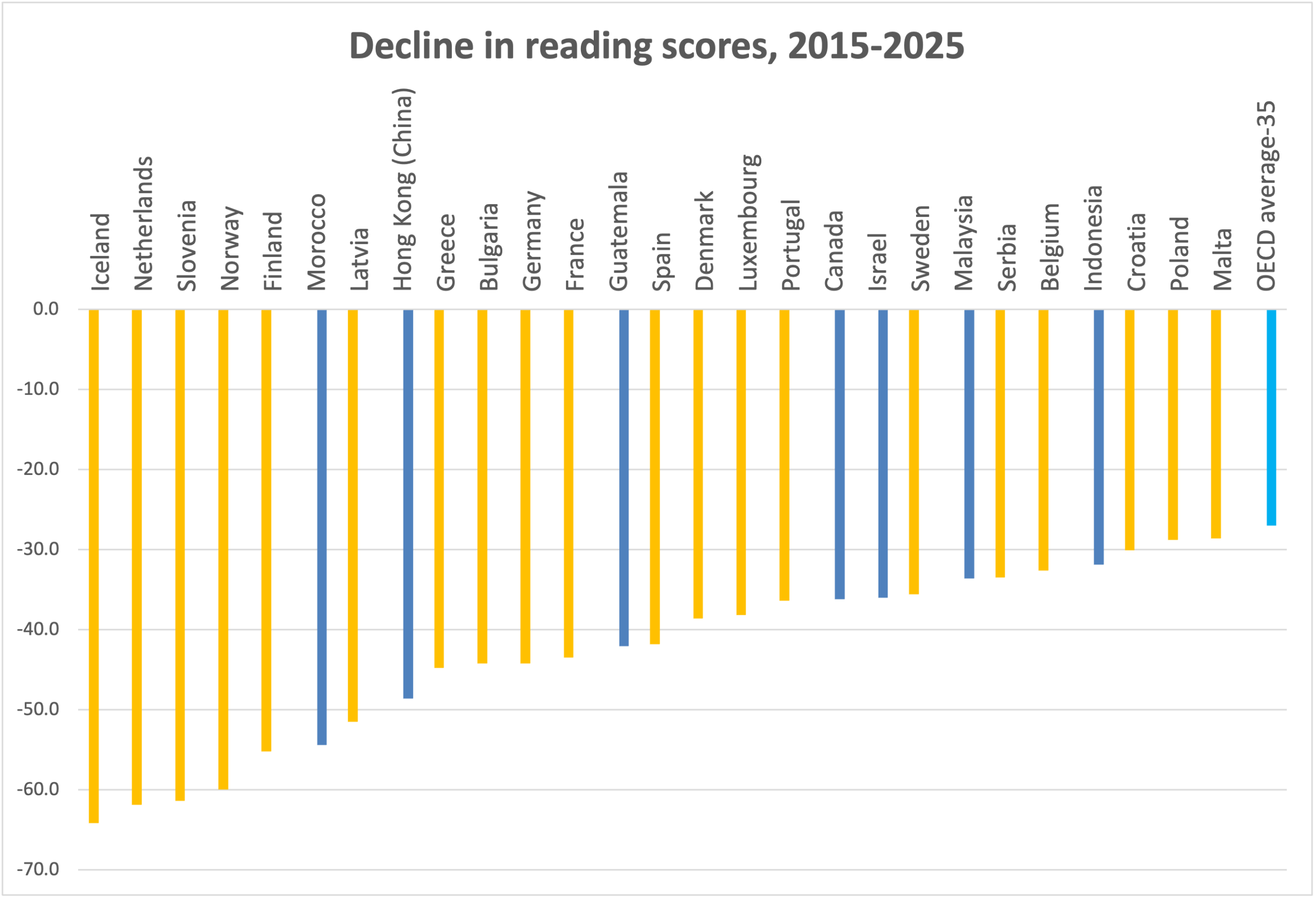
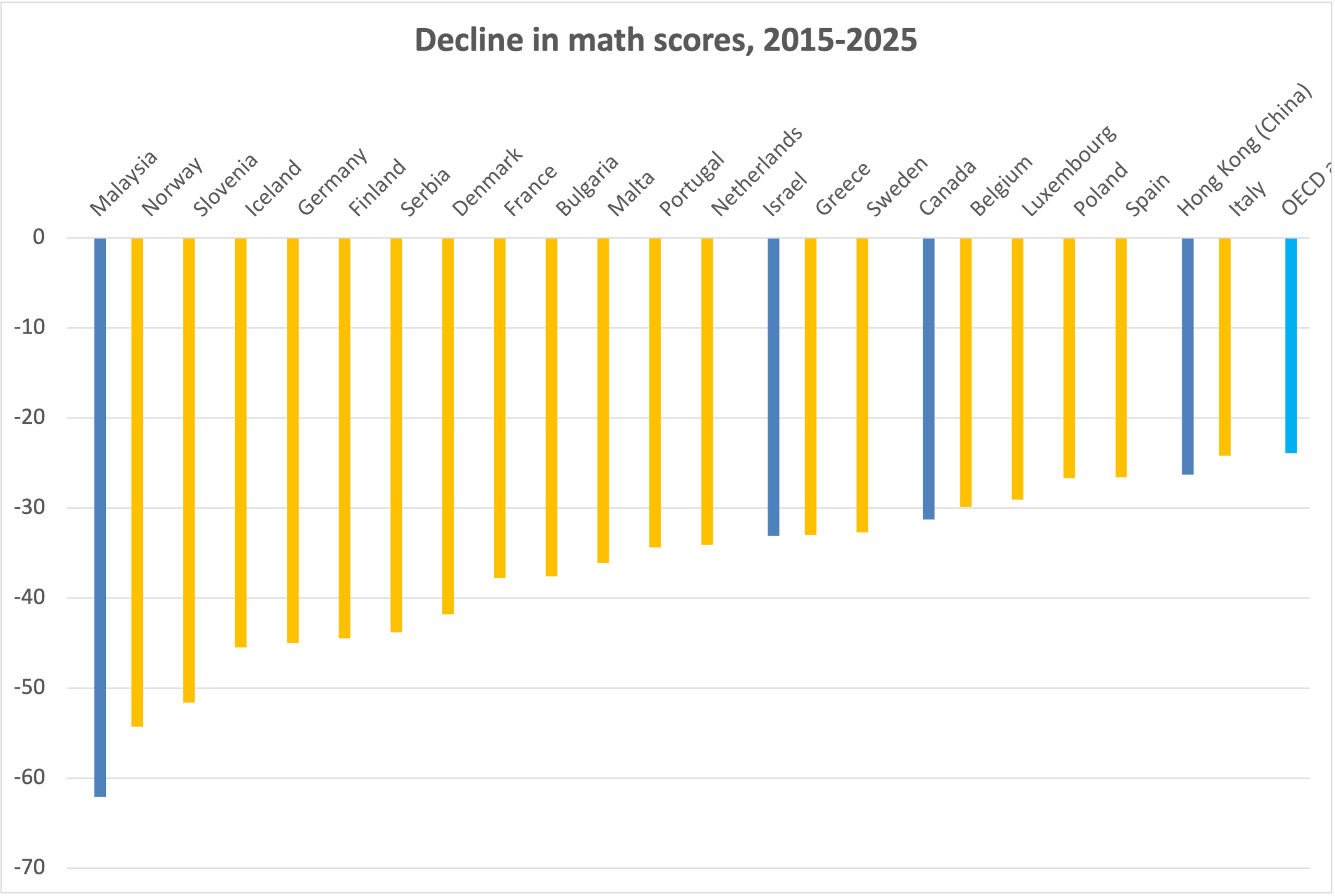
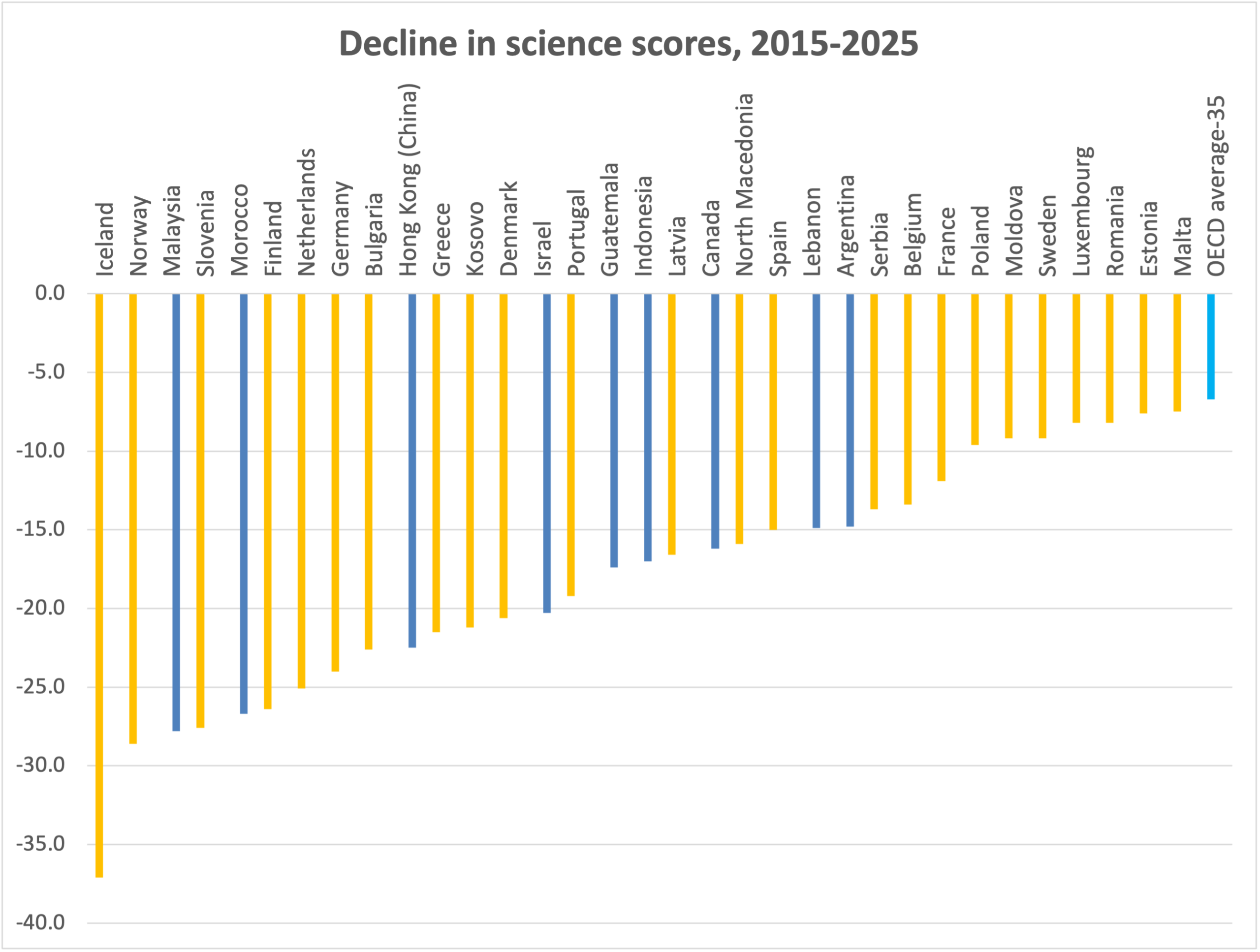
A few countries are improving, like Turkey, whose scores rose across all three areas. Some are holding up, like the UK. Asia keeps ahead of the pack while Europe keeps losing ground. Overall, however, the verdict is dismally clear: learning outcomes keep worsening. Students are losing interest, curiosity, and grit; their ability to think critically evaporates, and their performance in reading, math and science plummets.
I don’t know if AI agents are taking over, but it does look like humans are exiting stage left.
The original version of this article is published here
