
The China factor in Trump’s final stretch
 If Donald Trump intends to devote significant energy to foreign policy in the final stretch of his presidency, he will inevitably have to contend with the People’s Republic of China. Conciliatory rhetoric and frequent expressions of open admiration for Xi Jinping will not suffice to sustain a genuinely active and coherent policy toward Beijing. Thus far, the bilateral relationship has unfolded almost exclusively along the lines of economic pressure from Washington met with largely symmetrical – and demonstrably effective – countermeasures from Beijing, resulting in a fragile “truce” likely to be extended past its scheduled expiration in January 2027.
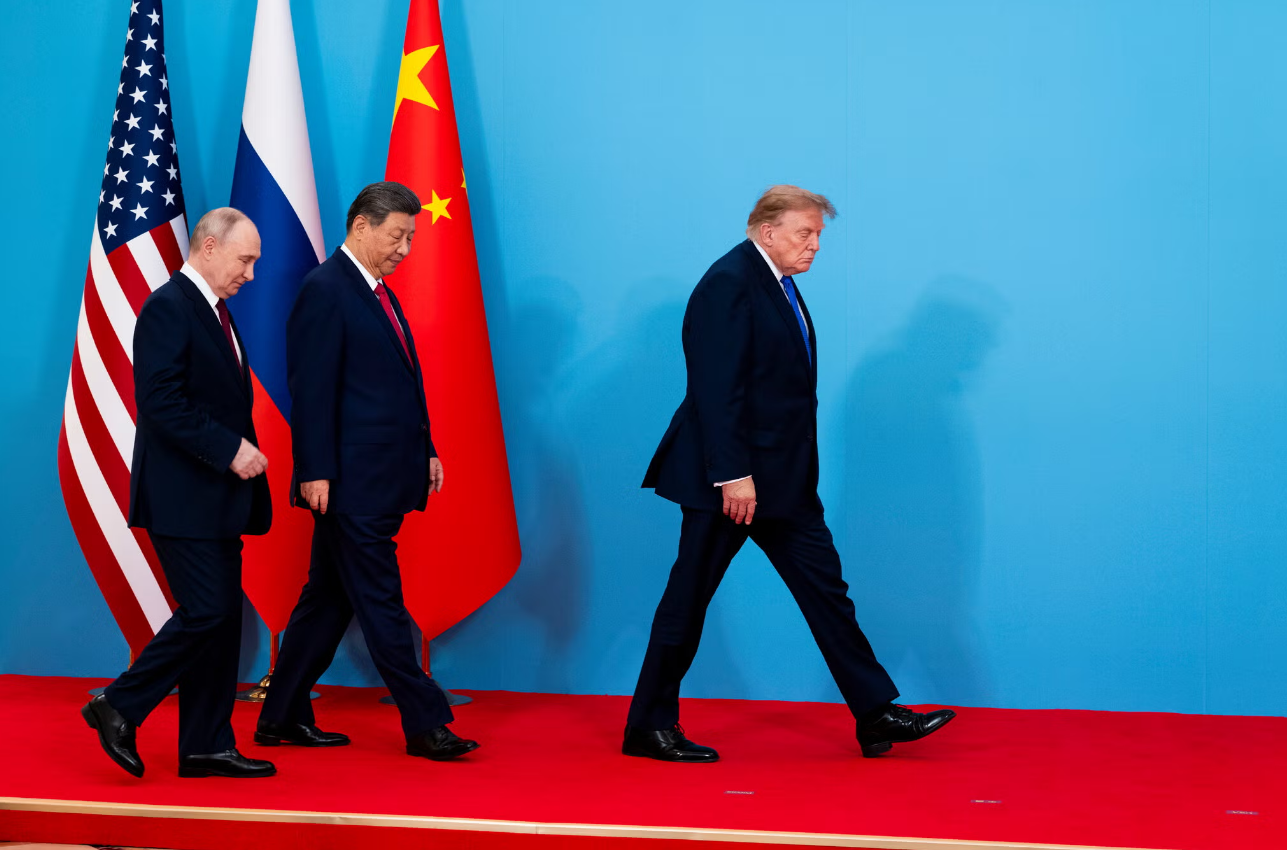
Across all major strategic dossiers, however – beginning with the overarching question of Indo-Pacific security, encompassing Taiwan, the Strait of Malacca, and beyond – Trump has proven above all to be a consummate procrastinator, failing to meaningfully execute the much-vaunted pivot of American strategic center of gravity toward Asia, almost as if the objective had been forgotten. While these stalling tactics have averted acute crises between Washington and Beijing, China nevertheless serves as a critical enabler of large-scale, high-intensity politico-military operations currently underway and squarely aimed at close US allies, or even American forces themselves: by Iran in the Persian Gulf, and by Russia in Europe. The resulting picture, at least at first glance, is sobering: China is advancing; America is wavering.
This dynamic was vividly captured at the Asia-Pacific Economic Cooperation (APEC) summit, whose 21 member economies account for roughly 60% of global GDP. Convening on November 18–19 in the futuristic Chinese metropolis of Shenzhen – today the very embodiment of Asian technological innovation – the gathering placed the People’s Republic and its paramount leader squarely at the center of global attention. The summit translated into striking visual terms Beijing’s position as the linchpin and vital hub of a new form of global interdependence – what international relations theorists term “embeddedness.” The two most prominent guests Xi hosted, Trump and Vladimir Putin, looked unmistakably like leaders of bygone superpowers, both mired in protracted wars from which they cannot extricate themselves, while the Chinese leader assumed the mantle of reminding the world of the virtues of globalization and stability.
Yet beyond superficial impressions and symbolic optics, the Shenzhen summit must be situated within a broader structural context to accurately assess the trajectory of Sino-American relations. Alongside the active conflicts noted above – spanning kinetic, cyber, and hybrid domains – loom major global challenges with profound medium- and long-term consequences. The second Trump administration will inevitably leave a consequential legacy for its successor, and the decisions made today will weigh heavily on the future.
The first of these issues, nuclear arsenals, can be dispensed with quickly: China has zero interest in binding itself to arms control agreements or treaties amid a substantial expansion of its nuclear forces, a buildup proceeding in tandem with massive conventional rearmament. Starting from a far smaller baseline – roughly 600 warheads compared to more than 5,000 each for the United States and the Russian Federation – Beijing is clearly leveraging its economic and technological weight to narrow the gap. Rhetorical nods to cooperation notwithstanding, nuclear deterrence and arsenal modernization will continue to define the coming years.
Closely tied to military affairs is the evolution of artificial intelligence, an arena of intense competition driven by the conviction that a decisive edge in AI will translate directly into strategic superiority. Indirectly, this also means that Washington and Beijing will effectively set the global parameters for full-spectrum digital competition.
Read also:
An American view of Europe’s “Strategic Autonomy”: a win for China?
The latest BRICS Summit: India’s test, China’s shadow, and Europe’s dilemma
Equally bound up with national security is the emerging space economy, where the United States and China are laying the groundwork for an unprecedented expansion – literal, not figurative – of humanity’s physical and economic horizons. A new geoeconomic landscape is taking shape through the convergence of advanced engineering, materials manufacturing, and scientific expertise.
Though hardly a new issue, climate change mitigation and adaptation also demand attention. It has been evident for at least a decade that without constructive engagement from both Beijing and Washington, no effective global climate framework is possible. Despite China’s rapid ascent to the forefront of green technology, achieving meaningful reductions in emissions and structural shifts in production and consumption requires binding multilateral commitments, not merely well-funded, ambitious domestic industrial policies. As for the United States, the final two years of the Trump presidency offer little reason to expect a reversal of course.
Furthermore, even in the near term, the U.S.-China duopoly possesses the capacity – whether by design or as collateral damage – to inflict near-irreparable harm on entire sectors of European industry. The United States remains the indispensable pillar of a vast transatlantic economy inherited from the Cold War, yet one that continues to represent an unmatched, deeply integrated space of prosperity – particularly when accounting not only for trade in goods, but also for services and cross-border investment flows. China, meanwhile, stands as Asia’s engine of growth and innovation, seeking to bind itself even more tightly to the European peninsula – a lucrative and stable market coveted by all – by gaining footholds in critical entry points, notably ports and infrastructure corridors. Should the world’s two largest economies accelerate the weaponization of their supply chains and the chokepoints they control, even a wealthy, expansive bloc like the European Union’s single market risks finding itself trapped, if not crushed.
Looking beyond economics to Europe’s broader strategic landscape, there is, of course, Russia—today a junior partner to Beijing, yet a nation that continues, under Putin’s aging and diminished leadership, to seek to maximize its continental and even “Eurasian” stature, as underscored by his November 18 address in Shenzhen. In reality, behind Moscow’s vague overtures toward a “Eurasian partnership” lies a transparent effort to break out of the diplomatic isolation brought on by its invasion of Ukraine – a decision that severed long-standing ties with major OECD economies and radically distorted Russia’s domestic economic structure.
Nonetheless, the challenge remains acute for Europeans, given that the Russian Federation is a geographically vast neighbor posing formidable conventional and hybrid threats. Rethinking a genuine pan-European security architecture has become an urgent priority, extending well beyond the necessary commitment to bolstering deterrence, territorial defense, and counter-offensive capabilities within both NATO and the EU. Crucially, however, this cannot be done on the terms Putin seeks to dictate – namely, granting Moscow a de facto veto over NATO’s posture on its eastern flank and a privileged right of interference in Ukraine’s future. Throughout all of this, China remains the proverbial elephant in the Eurasian room, given its demonstrated willingness to back Russia indirectly in activities that undermine intra-European security and cohesion, even as Beijing pursues its own parallel campaigns of disinformation and a persistent divide et impera strategy toward EU member states.
Whatever President Trump’s intentions and ambitions may be, the next two years will inevitably force difficult choices on the China front – a challenge the White House has thus far sought to manage through a form of “issue de-linkage,” keeping contentious dossiers compartmentalized in the apparent hope that relatively stable leadership-level ties might blunt the sharpest edges of bilateral friction. On closer inspection, this approach is the exact inverse of the strategy Trump has applied to America’s closest allies, who have been systematically subjected to aggressive “issue linkage”: tariffs deployed as leverage over defense spending; the threat of reducing U.S. troop deployments in Europe used to extract trade concessions from Brussels; and support for Ukraine conditioned on European purchases of American weapons systems. The net result is that ties with traditional partners have frayed, while Washington has secured few meaningful concessions from Beijing or Moscow – let alone assistance in managing the Iran problem. Whether the coming months will bring a course correction toward transatlantic and traditional alliances remains to be seen, though in Shenzhen Trump signaled a “different course” in triangular diplomacy exclusively with America’s two historic adversaries.
Read also: China’s networking foreign policy versus Trump’s disruptive challenge
What is certain is that Xi Jinping’s hyper-centralized party-state will continue down the path of weaponized networks and strategic chokepoints – a sophisticated domain in which China has cultivated far greater expertise than the United States, particularly under an administration that disdains interdependence largely because it appears not to fully grasp how it operates.
The trilateral meeting in Shenzhen among Xi, Trump, and Putin was undoubtedly historic, and it at least reaffirmed the three leaders’ willingness to keep channels of communication open – a positive development in itself. Yet it failed to move the needle on the foundational challenges weighing on international security. Rather than indulging in fantasies of a “new Yalta” – a particular fixation of Putin’s, widely and fruitlessly speculated upon on the eve of the APEC summit – the United States would do well to summon the foresight and strategic competence to see the twenty-first-century world as it actually is: far too complex and interdependent for obsolete formulas of great-power politics that no longer apply.
Here for the Italian version of this article.
