How Syrian Kurds suffer the evolving balance of power
In the early days of January, Syria took yet another sharp and violent turn away from the peaceful trajectory many had hoped for. Just over a year after the country had experienced a fraught mix of relief and anxiety with the toppling of Bashar al-Assad’s regime at the hands of Islamist group Hay’at Tahrir al-Sham, following another impasse over the so-called March 10th agreement with the Kurdish-led Syrian Democratic Forces (SDF), Syrian interim President Ahmad al-Sharaa’s transitional government launched an offensive against two majority-Kurdish neighborhoods in Aleppo that later expanded into SDF-held Northeast Syria (NES).
The spark that allegedly started the fire, the embers of which had been burning long before January 2026 for those who observed closely, was the killing of government police forces in the outskirts of the city, which Damascus blamed on SDF suicide drones, despite the SDF’s categorical denial of its presence in the area. Had the SDF actually been there, they would have been in violation of a previous deal with Damascus, which saw the SDF accepting that the Asayish in the Kurdish-majority neighborhoods in the north of Aleppo, namely Sheikh Maqsoud and Ashrafiyeh, “will be transformed into public security forces” and will be placed “under the administration of the Democratic Autonomous Administration of North and East Syria.”
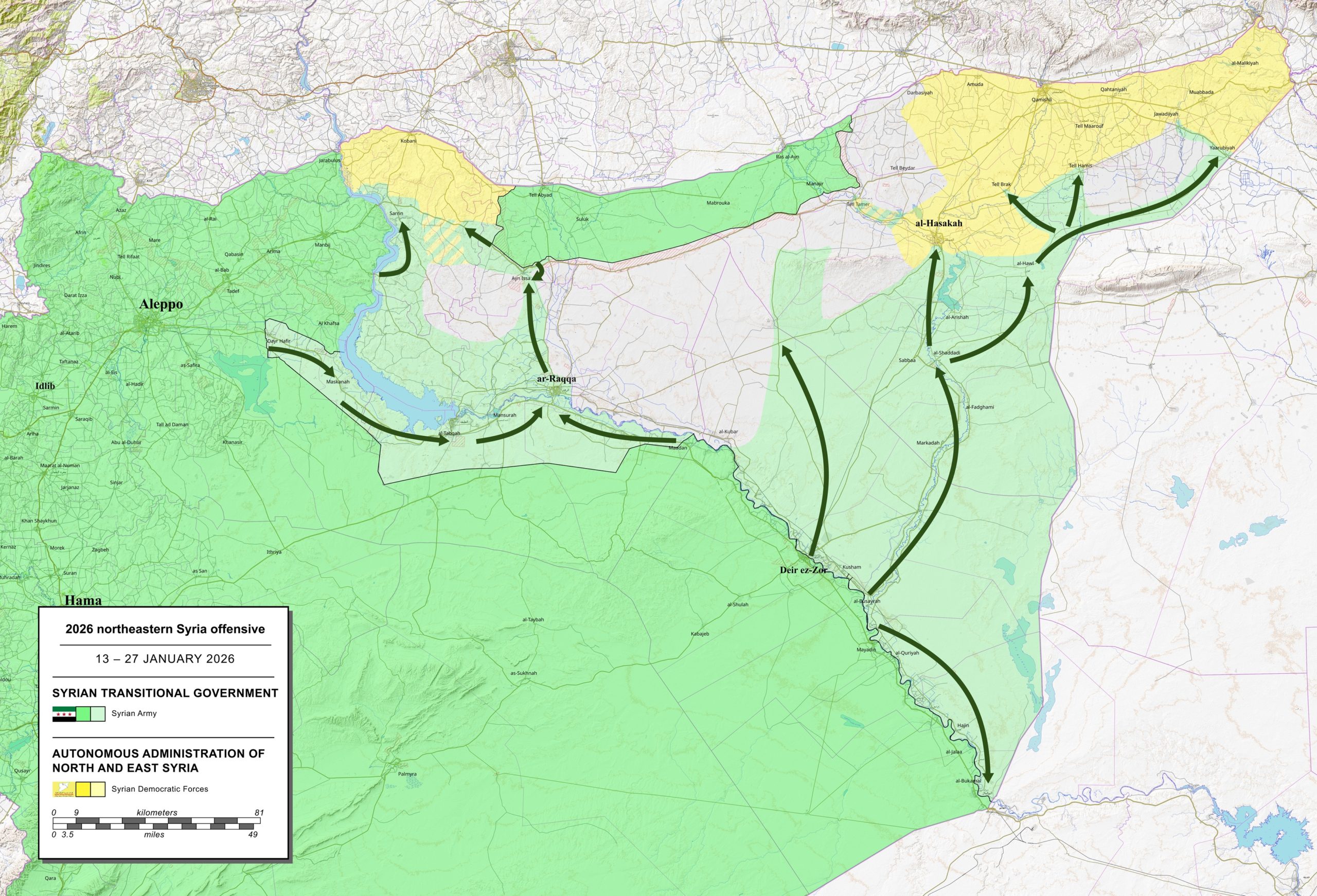
In the three weeks since that initial attack, Syrian Transitional Government (STG) forces launched an offensive on SDF-held areas, dramatically redrawing the map of a region that had functioned under semi-autonomous status for nearly 14 years. The operation swept through the Euphrates and Tabqa regions, which came under STG control together with the key strategic point of the Euphrates dam. Despite previous agreements and regardless of US warnings, STG kept pushing deeper east, towards Raqqa, where it secured another flashpoint, that of the Tishrin Dam, and Deir Ezzor before reaching Kobane, the symbol of SDF victory over the Islamic State of Iraq and Syria (ISIS), which remains besieged by STG forces since 19 January. An essential element to deciphering the unfolding of events is US Special Envoy for Syria Tom Barrack’s statement that the SDF’s role as the “primary anti-ISIS force on the ground” has “largely expired” in view of the STG’s readiness to assume security responsibilities.
Damascus and Qamishli
It is not easy to make sense of the diverging accounts of what the latest developments in the north-east of the country are and how the relationship between Damascus and the SDF has evolved over the past year and continues evolving amid the recent escalation. Everything is always brought back to the implementation or lack thereof, of the March 10th agreement. Over the past weeks, analysts and officials, domestic and foreign alike, have invoked the harsh necessities of statebuilding to justify and contextualize al-Sharaa’s offensive.
The March 10th agreement was never a done deal – it was a negotiation to keep negotiating; a framework. The document was a vaguely worded accord to move toward the integration of SDF civil and military bodies into state institutions, the drafting of constitutional guarantees for all communities, and cooperation against remnants of the Assad regime and other threats to security. An SDF source reportedly described the ever-so-quoted agreement as a “memorandum of understanding” that deferred all contentious questions such as military, administrative, economic, and resource integration to future joint committees. This leaves unresolved core disputes such as whether the SDF would integrate as a unified force or dissolve into individual enlistment, which would become one of the most contentious points in talks with Damascus, and ensures that no tangible change would occur without full consensus on implementation.
Throughout the course of the year, the SDF, not-so-long-ago hailed globally for their role in the fight against ISIS, which Barrack specified was the primary justification for US military presence in north-east Syiria, morphed in the eyes of mainstream media and commentators into Kurdish militias failing to uphold their side of the bargain. A startingpoint should be that equating the SDF to a Kurdish militia is factually wrong as it overlooks the role of its Assyrian, Turkment and Arab elements, many of which have defected in recent weeks, contributing to the swift fall of majority-Arab cities like Raqqa and Tabqa. There are also several elements that ought to be taken into consideration when discussing the lack of implementation of the March 10th agreement, in order not to fall into oversimplistic narratives.
Firstly, the foundations of trust on which such an agreement should be based in order to warrant any hope of smooth implementation had already been weakened before the agreement was even signed. The days leading up to the agreement were characterized by the summary executions, mistreatment and abuse that Alawites bore the brunt of following the STG’s deployment of forces to the coast to respond to an insurgent attack, combined with gradually mounting US pressure on the SDF to sit down at the negotiating table with Damascus and accelerate integration. The deal emerged from that context – not as a moment of trust-building, but as a response to converging pressures. Moreover, the publication of Syria’s constitution for the transitional period in March 2025, which concentrated power heavily in the presidency, reaffirmed a centralized state model, and offered minority rights largely in declarative rather than enforceable terms, further eroded the Kurds’ trust in Damascus, as can be inferred by Syria’s Kurdish National Council’s criticism of the seven-member, all Sunni Arab, constitutional drafting committee, which it claimed “does not represent the various political, national, and religious components of Syria, stripping it of inclusiveness and national consensus while reinforcing exclusion and monopolization of power.” By July, the clashes in Suwayda, which resulted in the death of about 600 people, completed the picture, reinforcing among minorities, including the Kurds, the sense that little had changed beneath the surface, and that old habits of governance – and coercion – had merely been repackaged.
The main requests and proposals advanced by the SDF between March 2025 and January 2026, namely integration into the Syrian army as a unified force structured into three divisions rather than through individual enlistment and demands for constitutionally enshrined political, cultural, and administrative rights within a decentralized framework, were consistently rejected by Damascus. This has led to the stall in talks at the end of the year, when the clock was running out on the framework agreement – the specifics of which were never agreed upon -, and then to the current confrontation between Syrian Government Forces and the SDF in NES.
Read also: La nuova Siria non ancora riappacificata
Against the backdrop of the ongoing offensive, on January 17th, al-Sharaa issued a decree recognizing Kurds as an “authentic component” of the Syrian people and affirming their linguistic and cultural rights. The decree reversed the effects of the 1962 Hasakah census which stripped Syrian Kurds of citizenship, and declared Newroz a national holiday. While the Autonomous Administration welcomed the gesture, it stressed that true guarantees can only be granted by the constitution.
On January 27th, aceasefire that had been reached through US mediation was ultimately formalized into a permanent ceasefire and integration deal. Under the latest agreement, the SDF would nominate representatives to some state positions and share governance over the administration of Kurdish-majority areas pending further integration.
Turkey: the new Syria’s oldest ally
For Turkey, which was perhaps the only actor to be less surprised than the SDF themselves by al- Sharaa’s offensive into SDF-held territory, Damascus’s northern offensive marked a step in the direction of the realization of a long-standing strategic objective, a natural extension of a policy framework Ankara has been refining for nearly a decade: the dismantling of any experiment in Kurdish self-administration along Turkey’s border.
After the fall of Assad, Turkey had emerged arguably the strongest external actor in Syria—reaping the dividends of a long-term strategy aimed at reshaping the country’s north. The consolidation of Turkish influence over Northwest Syria, which was subjected for years to economic dependency on its northern neighbor, its military presence, and administrative entrenchment, has turned Ankara into a de facto co-architect of Syria’s post-Assad future.
Turkey’s influence over Syria had for years been directly projected through the Turkish-backed Syrian National Army (SNA), whose primary mission had always been to contain the Kurdish threat. Within this framework, the Democratic Autonomous Administration of North and East Syria (DAANES) and its military backbone, the SDF, are not local governance experiments in President Recep Tayyip Erdoğan’s eyes but a direct extension of the Kurdistan Workers’ Party (PKK), classified by Turkey, the US and the EU as a terrorist organization, and seen by Ankara as an existential threat. In light of these elements, it is unsurprising that in the weeks preceding Damascus’s ongoing offensive into NES, Turkish Foreign Minister Hakan Fidan stated that Ankara would not hesitate to intervene should Damascus come under further attack, with Defense Minister Yaşar Güler reinforcing the same message. Such statements, while far from rhetorical, are partly rendered empty threats by the fact that arguably Turkey is already intervening in Syria, and has been for a long time.
Read also: Qatar, Turkey, and the rebuilding of the Muslim Brotherhood
What would constitute a shift, however, is a full-scale direct Turkish intervention—an unlikely prospect at a time when Erdoğan is delicately navigating internal power plays. At the heart of these, is an attempt to revive Turkey’s Kurdish peace process, leveraged by Erdoğan in pursuit of parliamentary support from the pro-Kurdish DEM Party ahead of the next elections.
This domestic dimension is inseparable from Ankara’s regional assertiveness, especially when it comes to its posture towards the Kurds. On February 27, 2025, less than two months after the fall of Assad, Turkey secured another huge victory when Abdullah Öcalan, the long-imprisoned founder of the PKK, called on the organization and its affiliates to lay down arms and dissolve. While the process has been slowly inching forward, the question of what that meant for the SDF was never clarified. While Turkey has been advocating, in no uncertain terms for the disarming and integration of the SDF, the latter’s Commander-in-chief, Mazloum Abdi, was quick to declare that the dissolution order did not apply to the SDF, continuing to deny any formal links to the PKK.
Turkey – Syria – Israel: A banquet set for three
On January 6, 2026, Syrian interim Foreign Minister, Asaad Hassan Al-Shaibani met with Israeli officials in Paris, marking their first direct engagement in months. The meeting, facilitated by the US, is part of US President Donald Trump’s quest to persuade Syria to join the Abraham Accords, his administration’s flagship Arab-Israeli normalization initiative, launched in 2020. Syria, fresh from regime change and seeking to rebrand its regional posture, was now apparently deemed a viable candidate.
The outcome of the Paris talks was the establishment of what the US State Department statement described as a trilateral “fusion mechanism”: a communications cell designed to enable “immediate and ongoing coordination on their intelligence sharing, military de-escalation, diplomatic engagement, and commercial opportunities,” under American supervision. The US framed the platform as a conflict-prevention tool, intended to reduce risks of miscalculation, foster economic integration, and support “regional prosperity.”
Absent from either the American or Israeli statements was any mention of the Kurds. This omission is not an oversight. This is particularly evident especially in light of the fact that in 2025, amid intense clashes between the SDF and Sharaa’s transitional government, Israeli officials, causing a stir in Ankara, had signaled their support for Kurdish self-governance and called for international support for Kurds in Syria, in line with Israel’s divide et impera approach to the calibration of its relations with minorities in Syria. That stance appears to have evaporated. In the Israeli government’s statement on the Paris meeting, officials highlighted the need to “ensure the safety of the Druze minority in Syria,” but conveniently omitted any mention of Kurds.
The Turkey-Israel rivalry over the future of post-Assad Syria, stemming from diametrically opposed views of what the division of power in the country should look like, has been one of the most defining relationships in terms of impact on regional dynamics in the last year. This, coupled with the acknowledgement of Damascus’s quasi-symbiotic relationship with Ankara, raises inevitable questions about Turkey’s role in this diplomatic choreography. The most plausible reading is that when courted by Washington and asked to name a price that would make it willing to give the go-ahead for the Syria-Israel talks to resume, Ankara did exactly that, sealing the fate of Rojava. A handshake for a gunshot, a negotiation for a long-sought offensive. Washington’s silence as the offensive expanded eastward, despite initial warnings, and its tirelessness in mediating ceasefires between the SDF and Damascus, reads like deliberate ambiguity. Israel, for its part, quietly toned down its previously vocal support for Kurdish autonomy.
America’s rehearsed abandonment of Syrian Kurds
The US architect role in the collapse of Rojava is not a rupture – it is a re-run. Under President Trump’s second term, Washington reprised the same calculus that defined his 2019 decision to withdraw troops from north-east Syria, a move that gave Turkey the greenlight for Operation Peace Spring, which resulted in the displacement of thousands of Syrian Kurds. The déjà vu started already in 2025, with talks of the US pulling out of Syria completely, Washington’s increasing pressure on the SDF to integrate into the Syrian army, and Trump’s all-in bet on Sharaa’s ability to unite Syria, or rather his capacity to stitch it back together independently of whether the wounds had been healing, were even treated, or if the patients trusted the doctor in the first place.
Read also: Saudi Arabia and the US: Aligned on Syria amid uncertainty on Gaza and Iran
In the last weeks, Washington clearly stated that its support to the SDF was a transactional one based on the necessity of having a trust-worthy interlocutor to coordinate with on the fight against ISIS and its containment, and that with al-Sharaa in Damascus there is no longer the need to keep Qamishli on speed-dial, or in the contact list.
Nevertheless, it remains to be seen whether in the long-run this calculus will prove to have been myopic or not, especially in light of the fact that SDF-run ISIS prisons in NES saw mass escapes. Against the backdrop of ISIS detainees being transferred to Iraq, a practice that started prior to the January 2026 offensive, increased US pressure on Baghdad to dismantle Iranian-backed militias, raising questions about how things will unfold, especially in light of Iraq’s ongoing government formation process, and Iran’s refusal to see its influence in the region further weakened, amid upheaval at home.