
Greenland and its subsoil
[[ Find here the Italian version of this article ]]
In recent years, Greenland has forcefully entered the global geopolitical debate as a potential “treasure chest” of strategic mineral resources. The growing international interest in the island is often linked to the energy transition, the security of supply chains, and the competition between great powers in the Arctic.
However, a factual analysis—one based on verified data from reliable sources and global comparisons—suggests a more sober reading of the political-media hype fueled, in particular, by the current U.S. presidential administration. Greenland does indeed possess relevant mineral resources, but they are not exceptional, and above all, they are not immediately transformable into a sort of industrial, economic, technological, or generally strategic advantage – in other words, power politics.
Rare earths and critical minerals
According to the United States Geological Survey (USGS), Greenland holds, among other things, reserves of lanthanides—the famous rare earths—estimated at approximately 1.5 million tons, which is barely 2% of global reserves. While significant in absolute terms, this figure is modest, almost irrelevant, when compared to the global landscape.
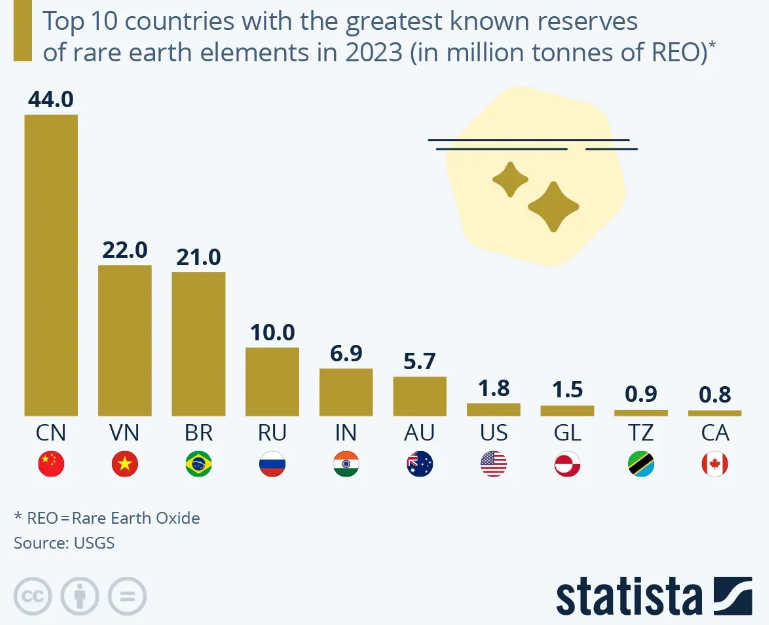
In terms of extraction, Greenland’s production is currently zero, while China covers over two-thirds of global production.
A similar comparison applies to other minerals defined as “critical.” Estimated graphite resources hover around 6 million tons, while lithium is valued at approximately 235,000 tons. In both cases, these quantities account for less than 1% of the global scale for graphite and an even smaller fraction for lithium. The same applies to other potential materials, such as uranium or nickel; they are present in Greenland’s subsoil, but in quantities that do not economically justify capital investments, and are certainly not comparable to traditional mining countries like Australia, Chile, China, or Canada.
Geological and logistical problems
Added to these figures is an element often—and perhaps intentionally—overlooked in political debate: the geological complexity of Greenlandic deposits. European geological studies and independent analyses highlight that many of the mineralizations, particularly rare earths in the south of the island, present a complex and atypical mineralogy. This makes extraction and, especially, industrial processing technically difficult and expensive.
Key takeaway: It is not just about how much mineral is in the ground, but how it is physically and chemically embedded in the rock. This factor significantly reduces the competitiveness of Greenlandic deposits compared to other more economically accessible global sites.
The difficulties are not exclusively geological:
- Ice Coverage: About 80% of Greenland is covered by ice.
- Demographics: The population is extremely small and dispersed across a vast territory.
- Infrastructure: Extremely limited; many areas are reachable only by sea or helicopter, and only under favorable weather conditions.
Strategic maturity vs. geopolitical rhetoric
Greenland is geologically promising but economically and industrially immature. Its value lies in long-term potential—perhaps one or two generations from now—rather than in an immediate capacity to affect global supply chains. Furthermore, the true strategic bottleneck of rare earths is not just extraction but refining, a stage currently dominated almost entirely by China, which is completely absent in Greenland.
Ultimately, Greenland’s mineral resources are real but their global weight tends to be overestimated in political discourse, perhaps even instrumentally inflated by populist rhetoric. Rather than an “Arctic El Dorado,” the island represents a possible complementary option for future diversification, heavily constrained by geological, environmental, social, and economic limits for at least the next fifty years.
The Greenland issue appears to be a powerful “weapon of mass distraction” used by the American administration to keep both the U.S. public and allied nations occupied with speculative matters.
Verborum fucus—as Seneca might say, not being familiar with the expression “smoke and mirrors.”
