
How Europe can really reduce its energy dependence: five ingredients
The EU Commission President Ursula von der Leyen put it succinctly during the latest nuclear energy summit in mid-March 2026: “We are completely dependent on expensive and volatile [energy] imports. They are putting us at a structural disadvantage compared to other regions. […] We have home-grown low-carbon energy sources: nuclear and renewables. And together, they can become the joint guarantors of independence, security of supply, and competitiveness — if we get it right.”
This assessment captures an important truth — Europe is deeply dependent — but the proposed solution – boost renewables and nuclear – does not solve the issue on its own. The real solution for an optimal energy policy mix that makes Europe competitive, independent and decarbonized is a recipe of five ingredients in a setting where energy policy is not an exclusive competence at EU level.
A successful energy policy is relevant not only for energy-intensive consumers but also for the overall economy and the basic functioning of societies and businesses, because “economic advancement relies on energy”, in the words of Daniel Yergin, a Pulitzer Prize–winning authority on energy, politics, and economics.
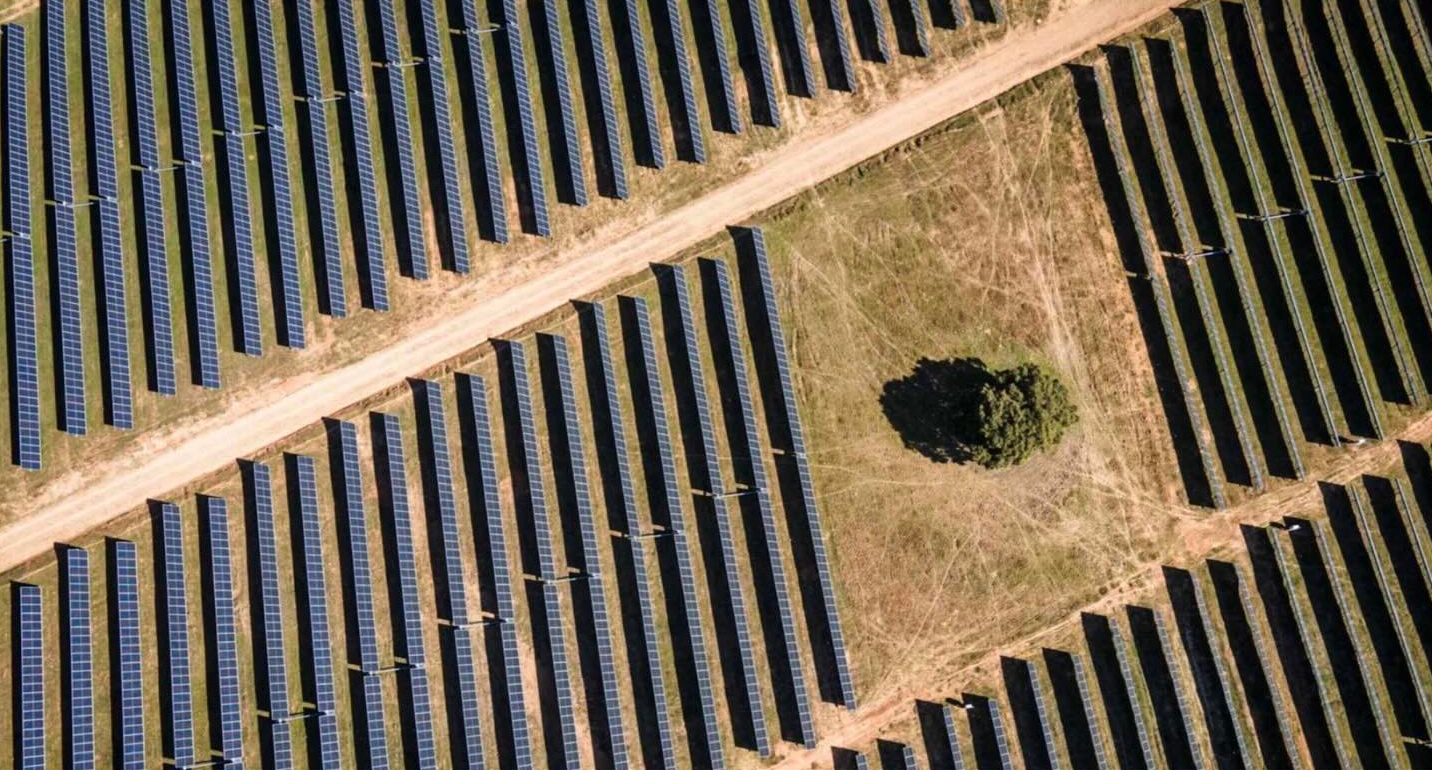
Thinking energy policy as an optimization problem of the “energy trilemma”
Each geopolitical shock revives a familiar refrain: Europe must achieve energy independence. The recent energy crisis triggered by renewed conflict in the Middle East has once again placed this debate at the centre of European politics. Yet approaching energy policy through the lens of a single objective misses the point entirely.
Energy policy is, at its core, about balancing the so-called “energy trilemma”: security of supply of energy, affordability (as low-cost sources as possible) and sustainability (mainly CO2-free energy). These three objectives are interdependent and in tension with one another. A policy that advances one at the significant expense of the other two falls short of what good energy governance requires. The goal, therefore, is not to optimize a single dimension, but to make steady, simultaneous progress across all three by giving more or less weight to each dimension according to the policy priorities—in other words, for readers familiar with mathematics, to maximize (or optimize) a function of three variables, whose parameters are bigger or smaller in light of the political priorities.
Sustainability: using CO2-free energy sources
Of the three pillars, sustainability is where the debate is largely settled, at least in Europe. Renewables (together with batteries to smoothen the effects of intermittent renewables such as wind and solar) and nuclear (after years spent to come to an agreement in Europe to admit nuclear in the so-called “taxonomy” or list of environmentally sustainable energy sources) are the only large-scale, commercially deployable, CO2-free electricity sources available to Europe at the scale the transition demands. No other technology comes close.
Carbon capture and storage (CCS) remain expensive and unproven at the volumes required. Hydrogen, despite all its long-term promise, is still not yet widely produced or efficiently delivered at scale. Gas and oil remain fossil fuels emitting carbon. Other renewables such as hydro and geothermal energy are of course useful to decarbonise the mix but are geographically constrained and not scalable enough to meet the future demand.
Affordability: making energy sources cheap
On affordability, renewables and nuclear share a defining characteristic: once the infrastructure is built, their marginal costs are very low or effectively zero.
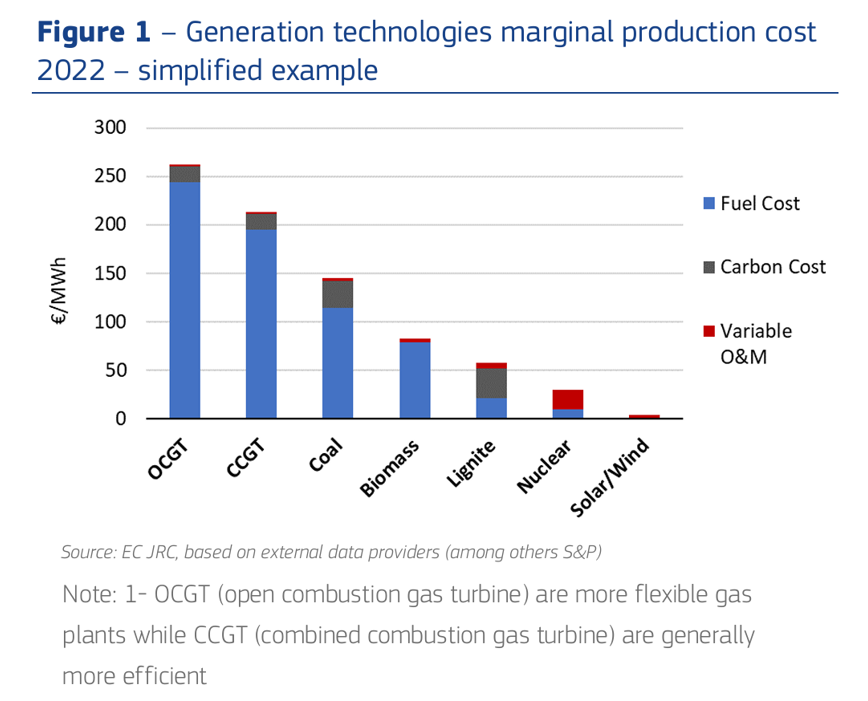
This matters significantly in electricity markets structured around the merit order principle: this is the economically most efficient system where power plants are activated (“dispatched”, using energy jargon) in order of lowest to highest production cost, with the most expensive plant needed to meet demand setting the market price.
In recent years, this marginal unit has often been a gas-fired power plant. As a result, it is common to say that “gas sets the price of electricity,” because gas plants frequently determine the market-clearing price. When gas prices rise sharply, as they did during the 2022 energy crisis and again during the Strait of Hormuz crisis more recently, electricity prices follow, regardless of how much lower-cost renewable energy is already in the system. The more a country is reliant on gas for its power production, the more this is true.
As the energy transition advances and the share of renewables and nuclear grows, the price-setting role is expected to shift away from gas, and wholesale electricity prices will tend to fall or stabilize. The wholesale electricity price will no longer be “set by gas”, but instead by sources such as wind or solar, for example. This is already observable in data from markets like Finland or Germany in Northern Europe and Spain or Greece during periods of strong renewable generation.
Read also: La rete dell’energia europea, verso un cambiamento epocale
Yet this presents a paradox. Intermittent renewable energy sources are heavily concentrated during periods of low demand and cannot be quickly curtailed or stored. The result is a two-sided pricing problem: oversupply during off-peak hours drives an increasing number of negative price episodes, while renewable shortfalls during peak demand hours push prices sharply higher. Crucially, these price spikes occur precisely when affordability matters most for households and businesses that cannot shift their consumption.
This means that scaling up renewable and nuclear capacity, while necessary, cannot be the sole answer to the affordability challenge. Expanding low-marginal-cost generation without addressing the underlying mismatch between supply and demand will perpetuate high prices at peak hours and create the negative pricing episodes that threaten the economics of renewable investment itself.
The missing piece is flexibility. Batteries and other storage and grid flexibility solutions are key elements to be coupled with the intermittent renewables. Without them, a low-carbon electricity system risks being both expensive when it counts and wasteful when it doesn’t.
Security of supply: making Europe more independent of external suppliers
The missing pillar of the energy trilemma is the security of supply. Today, Europe remains structurally dependent on others for much of its energy: 57% of the final EU energy use and 90% of gas consumption are imported (although 30% comes from Norway, which is in the European Economic Area).
This is certainly not a new observation. Europe has been exposed to successive crises: after the oil disruptions of the 1970s and the 2022 gas shock following Russia’s invasion of Ukraine, we now have the ongoing major crisis in the Persian Gulf – which has been defined by Fatih Birol (Executive Director of the International Energy Agency) the worst energy crisis we have lived in which “energy security has never been so threatened”.
In this context, von der Leyen is right that the energy transition offers a meaningful path towards greater sovereignty. Renewables and nuclear are “home-grown low-carbon energy sources” in the sense that they produce energy in Europe making them far less exposed to the kind of supply disruptions that oil and gas markets can experience.
However, an important point is worth making: CO2-free electricity generation does not automatically guarantee energy sovereignty. Without an accompanying industrial policy, it risks replacing one form of dependence with another.
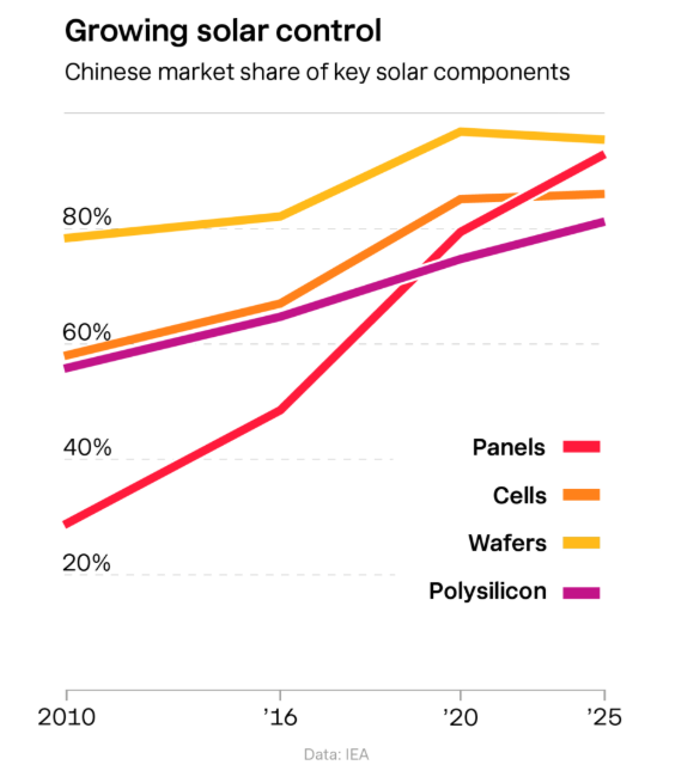
Consider the renewable energy supply chain: solar panels require inverters (the critical electronic interface that converts the direct current produced by panels into the alternating current used by the grid); wind turbines require rare earth magnets; digitalization (smart grids for instance) and battery storage require rare earths including lithium, cobalt, nickel, manganese, silicium, graphite, copper, aluminium. Much of the sourcing and manufacturing of these components is today concentrated in a small number of countries, most notably China.
A similar dynamic can also be observed in nuclear energy: although it is often presented as a domestically stable low-carbon source, it still depends on imported fuel such as uranium. Key suppliers include countries such as Kazakhstan, which is the world’s largest producer, and Niger, which has historically been an important supplier for Europe (France in particular).
These dependencies do not pose an immediate threat. Europe’s installed renewable and nuclear capacity will continue to generate for decades, and the geopolitical consequences of today’s supply chain choices are not yet fully visible. The risk is deferred. In 25-30 years, when Europe’s faces a massive renewable fleet renewal, it will need to source replacements at scale. If the manufacturing base remains as concentrated as it is today, Europe will find itself negotiating that renewal from a position of structural dependency. The geography will have changed, with China replacing Russia or Middle Eastern countries as the critical supplier, but the vulnerability will not.
What about electrification?
A lot of politicians and policymakers present electrification as a golden egg to help us obtain secure, affordable and sustainable energy. The latest example in European energy policy is the “AccelerateEU Plan”.
However, it is of paramount importance to remember that electricity is a secondary energy source. This has two specificities that can become advantages if used well.
First, its value depends entirely on how it is produced. Electrification only improves security, affordability and sustainability if the electricity itself comes from reliable, cost-competitive and clean sources. Otherwise, it can simply shift emissions and vulnerabilities upstream. For example, replacing petrol cars with electric vehicles reduces urban emissions. However, if the electricity used to charge them is generated from coal, overall emissions may remain high or even increase. However, if electricity is generated from sufficiently decarbonized sources through a diversified energy mix, electrification becomes a cornerstone solution to the energy trilemma.
Second, unlike fossil fuels, which lock us into a fixed carbon-intensive pathway with no alternative, electrification offers a fundamental strategic advantage: the freedom to choose. In fact, many sectors and industries today are deeply dependent on fossil fuels and structurally unable to escape them: a gas boiler will always need gas to operate. Electrification breaks this lock-in. By switching to electric alternatives such as heat pumps, we gain the power to choose what lies behind every kilowatt-hour we consume.
Yet Europe is falling dangerously behind on electrification. Only 22% of Europe’s primary energy consumption is currently electrified. It is below the United States at 23% and Canada at 24%, both of which can at least rely on substantial domestic fossil fuel extraction to offset import dependency. Well above, China’s share is at 27%, and electricity has already surpassed oil in the national energy demand mix (source : Share of electricity in total final energy consumption).
The five-ingredient recipe for an optimal energy policy
The big question is now: how can energy policymakers face these challenges and how should energy policy help Europe and its economy sail through an increasingly competitive and changing world?
The recipe for an optimal energy policy that solves the trilemma consists of five ingredients.
First and foremost, diversification is the way to go and key to solve the energy trilemma.
Speaking of more concrete energy-policy, renewables and nuclear are necessary but not sufficient. They generate sustainable, affordable (they drive down prices) energy but do not fully help with the security issue even with “Made in Europe” components because Europe is poor in rare earths, which are currently extracted and refined mostly outside of Europe (and concentrated in the hands of China).
The full answer to solve the energy trilemma function must be the diversification. As Fatih Birol has stated plainly: “The golden rule of energy security is diversification.”
The principle of diversification is simple: multiplying sources means dividing risks. Every additional energy source in the mix, every additional supplier in the chain, every additional country in the network reduces the exposure that comes with concentration.
Diversification is about both types of energy sources and geographical origin by sourcing from as many different countries as possible.
On this matter, it is essential to stop treating energy sources as rivals. The debate between nuclear and renewables is perhaps the most familiar example. The two technologies are complementary, not competing: nuclear provides stable, weather-independent power when the wind drops and the sun sets, while renewables offer speed and scalability that nuclear cannot match. Both are needed. More broadly, the goal of energy policy should never be to pick a winner, but to build a system that draws on the strengths of multiple sources at once. A diversified mix is more resilient, more affordable, and more sustainable than any single-technology bet. The question Europe should be asking is not which energy source to champion but how to combine them most effectively.
In its history, Europe has consistently broken the rule of diversification. Today, with the energy transition, there is a unique chance to “get it right”.
Second, local supply should be exploited and incentivized more, of course by considering and respecting other constraints, typically environmental and social ones. Europe is lagging behind but can catch up with three types of action. First, it should invest in innovation, research and development where it can make a difference as the electrification and the digitalization require an enormous amount of capital. Second, it should incentivize a “Made in Europe” supply chain for wind and photovoltaic power plants. Third, more exploration and production for energy supplies should be encouraged domestically.
Third, policymakers need to focus on the right things to avoid making mistakes. Europe’s energy debate too often focuses on the wrong issues—either on the ones that have already been resolved or the ones that do not deliver real results.
A good recent example of focusing on issues that have already been resolved is the debate on the electricity pricing merit order system (as defined earlier). Recently, in Brussels some politicians have raised concerns on this system, arguing that, in its current form, it disadvantages renewable energy and is “not a good solution”. Politicians tend to panic during high price periods and point fingers to the easiest scapegoat – how prices are formed. However, Europeans had this exact debate in 2022 after the Ukraine crisis, and Europe ran a thorough review (the 2024 Electricity Market Design reform), whose conclusions were clear: the merit order system works well and is the most efficient foundation for electricity markets (20261103_Statement_Marginal Pricing_Final). Reopening it now consumes precious political capital that could be directed elsewhere. Politicians change across time, so it is of paramount importance that they are advised by competent people and institutions that stay across time.
A recent example of focusing on issues that do not deliver results is the EU Emissions Trading System (the EU’s carbon market is a typical cap-and-trade system, in place since 2005, that caps greenhouse gas emissions; companies trade emission allowances to encourage cost-effective pollution reduction). Despite the attention it receives in policy circles, ETS allowances represent less than 10% of the final consumer electricity price (in 2024), making it, at best, a marginal lever on household and industrial energy bills. If the genuine objective is to lower prices, then the focus must shift to what actually drives the retail price, which is the wholesale price and the composition of the generation mix.
Fourth, we need more harmonization and more simplification of laws and policies to avoid unnecessary complexity.
Europe’s energy landscape is fragmented by design: energy policy is not an exclusive competence at EU level. This means that each of the 27 Member States retains significant autonomy to shape its own rules, targets and support schemes. The result is unnecessary complexity that makes policy decisions much less effective on the EU level and sharply reduces the negotiating power of EU members on global markets. To avoid this, there needs to be, a minima, a stronger alignment on energy policy priorities in order, for the Member States, to move in the same strategic direction rather than pulling in 27 slightly different directions. The fully fledged solution would be to give EU institutions an exclusive energy mandate at least on certain topics such as the negotiations of energy supplies with third parties. Although this may be currently challenging to achieve politically, it would make sense to achieve harmonization inside the EU and gain bargaining power with other global powers and energy suppliers.
Moreover, policymaking itself must become less complicated with simplified and stable compliance and regulatory frameworks.
Fifth and last, Europe must also get the timing of energy policymaking right. Adaptive and creative political leaders with a good sense of timing will save Europe.
Europe must act faster. The Old Continent has a chronic tendency towards slow decision-making. A challenge that the United States and China do not face to the same degree. Washington can mobilize massive industrial policy at speed, as the Inflation Reduction Act showed, and Beijing can deploy energy infrastructure at a pace Europe cannot match. Even if, by design, European decision-making may require more time, this must not be at the cost of being permanently late on structural reforms. Speed is not optional.
However, speed should never come at the cost of sound judgment. History shows that policymaking rushed in the heat of a crisis tends to produce reactive, poorly designed measures driven by panic rather than evidence. The right approach is to do the hard work of policy design during calmer periods, when there is time to model impacts, consult stakeholders and stress-test decisions before they are locked in.
Read also: The ‘New EU Green Deal’ and the quest for competitiveness
Finally, energy policy cycles are very long, they take at least a decade to be fully realized. Hence, keeping a consistent direction of policy provides the policy and legal framework consistency and stability that private investors need to implement sound business cases.
To do all this Europe needs political leaders that can understand the complexity of energy and economic policy, implement the recipe above, be advised by competent people and, above all, be bold, adaptive, creative and innovative in a changing world where old beliefs and alliances may disappear.
Europe and its economy and businesses deserve it.