Russia, Ukraine and the memories of World War Two
WWII is, among many other things, the myth of origin of the European Union. The problem with such myths of origin is that the very things at the origin often get elided and forgotten and stereotyped; they become something they never really were.
The moment that we are in recalls the Second World War in a number of ways, especially in light of ongoing events in Ukraine. First is its location. The war was fought and won and lost, not in France or in the Netherlands or in Britain, but in Ukraine and Belarus, something that is familiar to historians of the battlefields of WWII.
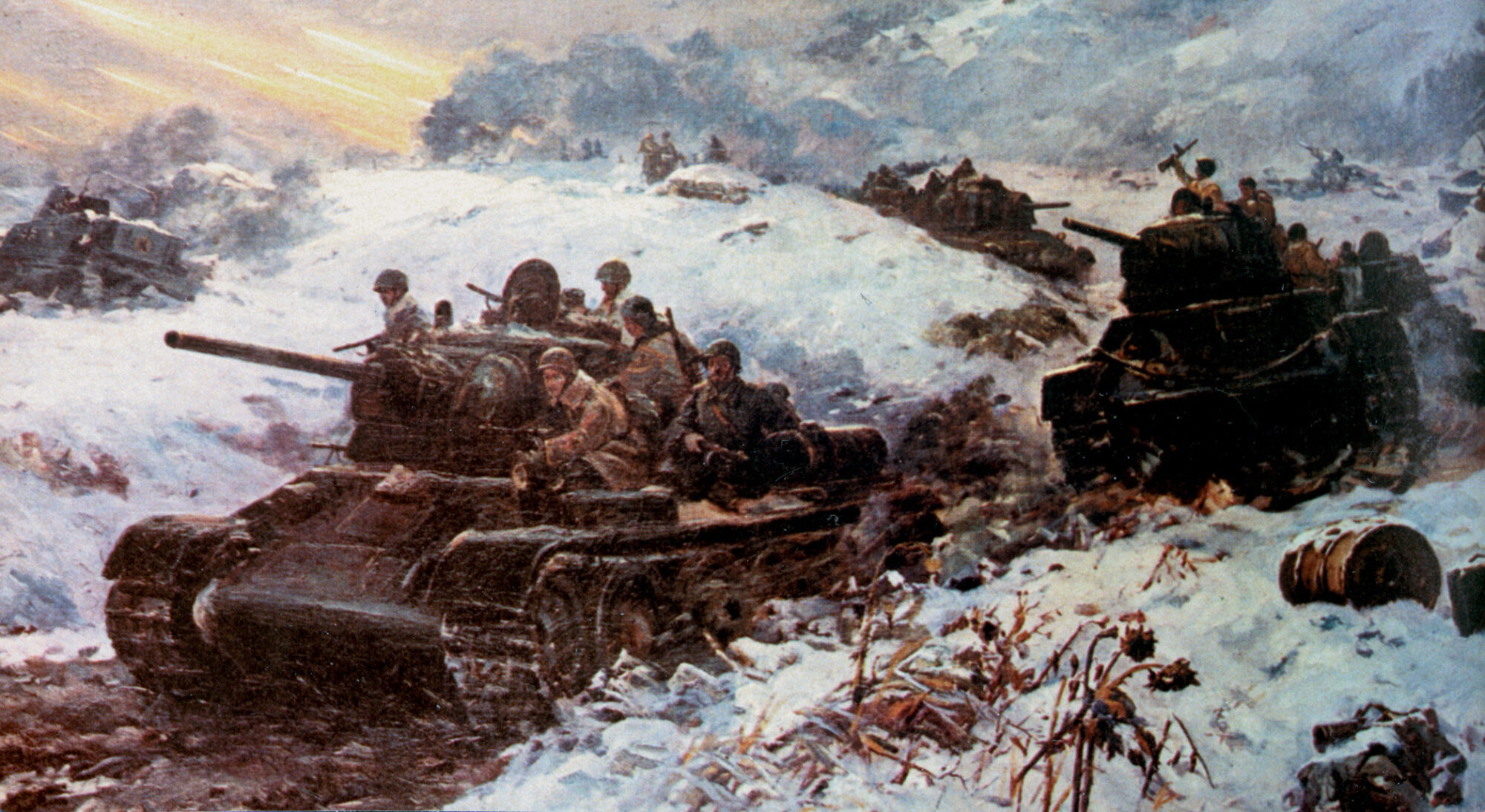
The rhetoric of the current war also reminds the 1930s and 1940s as it recycles Nazi and Soviet ways of looking at warfare. There is an ideological contest going on. It may not have the kind of openness and clarity that fascism and Stalinism and Churchill and Roosevelt had during the Second World War, but the Russian invasion is clearly a war against a democracy and against the principle of democracy. A flawed democracy to be sure, but still a political system where people are elected freely.
And the scale matters too: The Russians have already taken half as many casualties as the Americans took in the Second World War, including the Pacific theater. There is also the scale of civilian suffering and killings in Ukraine. Tens of thousands of Ukrainian children, according to Russian sources, have been deported and kidnapped for the purpose of Russification. Whether that is true or not is unclear but the Russians claim to have deported most of the population of the lands that they occupy, in the order of four to five million people, well over 10% of the population of the entire country. More than half of the citizens of Ukraine have been forced to move in one way or another.
Read also:
What Putin wants and why Trump seems willing to go along with it
Russia needs peace to maintain stability; Ukraine needs peace to survive
A state of mind: how conspiracy theories became the Kremlin’s ideology
During the Second World War cities were destroyed by various means, but if we count the coffins and the actual burials in Mariupol, the city in southern Ukraine which is now occupied by Russia, the scale of death there is roughly the same as Hiroshima and Nagasaki combined.
There are also interesting echoes of the Second World War in Russian legal theory about Ukraine. The German legal theory about Poland in the 1930s was that it had never existed, that it was not a state and therefore what was happening was not an occupation. The Russian legal theory about Ukraine is strikingly similar: Ukraine is a non-state entity. Putin gives various rationales for this: it was never a state because somebody got baptized a thousand years ago; it was never a state because of the communists; it was never a state because of the Nazis. In any case, the implication is that there is no occupation, or alternatively that Ukrainians do not constitute a nation and therefore what is happening is not aggression. This is redolent of German ideas applied in Eastern Europe during the Second World War.
Strikingly similar is also the theory of the “special military operation”. The logic is that because Ukraine does not really exist as a nation, the people who pretend to be Ukrainians are a thin, elite layer of the population. The physical elimination of those people will then lead to the collapse of all Ukrainian institutions. That was Hitler’s theory in Operation Barbarossa: in his reading, the Soviet Union was not really a state, there was just a thin layer of alien elites who would either flee or be crushed.
Such a conception is connected to a conspiratorial view of the world, as Putin makes the argument that Ukraine only exists thanks to the external intervention of Brussels or America, propping up “fake Ukrainians” at the top of the state. This country with its exotic elites only exists because of the way the world is organized.
The overall perception of Ukraine across Russian society is strengthened by the media narrative, with the ubiquity of genocidal propaganda against Ukrainians: they are consistently referred to as Satanists, devils, vermin, germs, pigs, ghouls, or vampires. The common denominator of these derogatory attributes is that anybody who identifies himself or herself as a Ukranian is not really a human being.
Against this background, it matters that World War Two is the founding myth of the EU because that it was a test of certain kinds of (mostly European) imperial structures, some of which survived, some of which failed[1]. Russia continues to see itself as an imperial construct. It also led to the standard conclusions that war is wrong; peace is better; and peace is achieved by way of economics.
This recognition also helps us to think more clearly about the relationship between economics and peace. In particular, the standard German argument for taking up Nord Stream 2 after Russia invaded Ukraine in 2014 had to do with the fact that economics determines politics and therefore economic engagement could not be bad. What was missing from that argument was that the economic engagement that happened with the aggressor after the Second World War occurred after the aggressor had been defeated – the economic project was begun by West Germany, whose elites acknowledged quite thoroughly that they had been defeated.
Economic integration is something quite different when you do it with an empire before it has been defeated. Today’s Russia is very old-fashioned in this respect. The natural resources that Russia has to offer, and for which Germans and others are paying, are extracted from a comparatively small part of the Russian Federation, thousands of kilometers away from the people who hold power. And the people who live near where the resources are extracted get basically nothing as a result. So, in that sense, it is a classic colonial relationship inside the Russian Federation.
From this perspective, the war against Ukraine is an imperial enterprise – fought, not accidentally, by mostly non-Russian citizens of the Federation. The centrality of colonial aspirations and colonial control of the territory to World War Two is one of the forgotten lessons of World War Two which we, as Europeans, ignore at our peril. And that also applies to the Russians, because ultimately the only way Russia wins is by losing.
Originally shared as “Empire, Integration, and Ukraine” by Timothy Snyder on Thinking about….
[1] For a more in depth analysis of this point, see Aspenia 3/2025.