
MbS in Washington: strong economic wins, mixed gains for defense
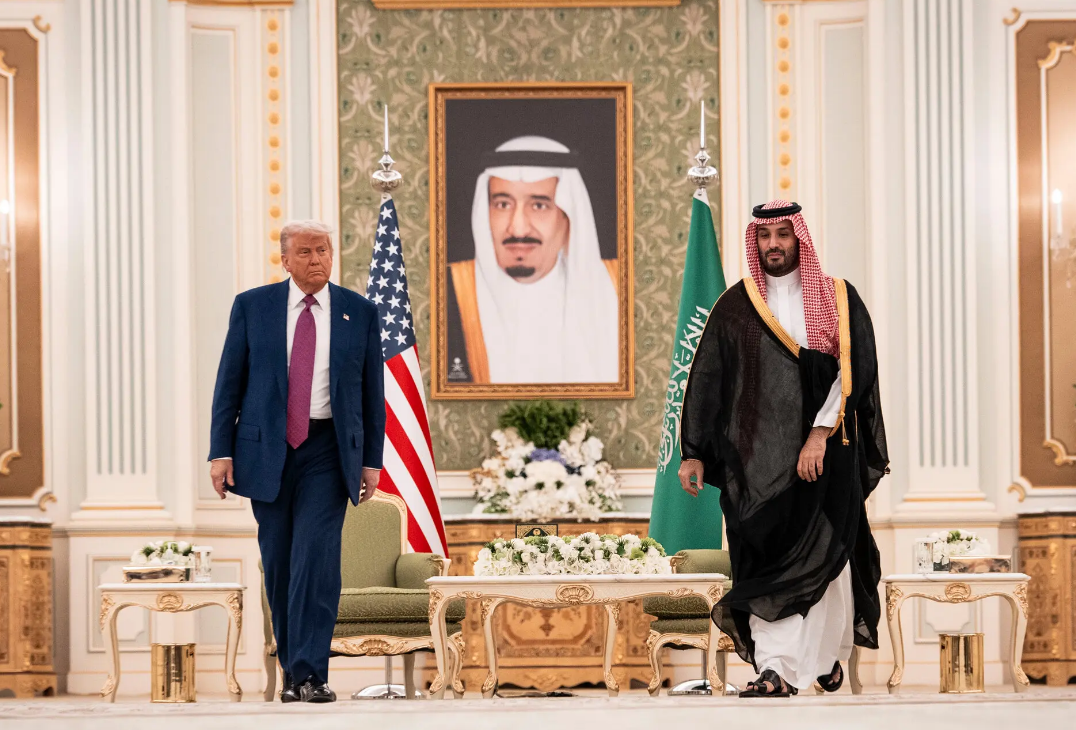
The visit of Saudi Crown Prince and Prime Minister Mohammed bin Salman Al Saud, also known as MbS, to the US on November 18-19, 2025 can be described as an economic victory, as well as a partial defense success for Riyadh. Saudi Arabia and the US are readjusting their special relationship exactly 80 years after King Abdulaziz ibn Saud and Franklin Delano Roosevelt met on the USS Quincy in Suez to shape the “oil for security” entente. In the ongoing formula, the alliance has partially replaced oil with technology, while the gradual, long-term defense integration path serves to redefine, on a partner level, the decreasing role of the US as the Kingdom’s security guarantor.
Economy: surfing the state capitalism wave
A first since 2018, the Saudi Crown Prince’s trip to the US consolidates the economic partnership outlined in May when President Donald Trump visited Saudi Arabia. Between Riyadh and Washington, the business mood looks excellent. This is favored – alongside the Trump family’s direct economic interests in the Kingdom – by the current administration’s propensity to pursue a form of state capitalism in strategic sectors, which matches well with how Gulf leaders design and implement their markedly top-down national visions. Signed agreements focus on key sectors for Riyadh’s post-oil diversification, from the innovation industry and artificial intelligence to critical minerals.
The AI Strategic Partnership will support Saudi ambitions to become a tech hub, accelerating the green light for the export of US semiconductors: chips are decisive to the localization of Saudi industry, including defense production. In the Kingdom, military expenditure was locally invested for a 19% in 2024, a notable increase compared to 4% in 2018, though still far from the ambitious 50% target expected by 2030.After MbS’ trip, Riyadh received the authorization for Washington’s export licenses, after it reached an agreement in May to buy advanced chips from the US company Nvidia. In October, the US already issued Nvidia’s licenses to export chips to the United Arab Emirates.
Read also: Global sport and the Gulf’s sovereign wealth funds
The Critical Minerals Framework signed by Riyadh and Washington centers on securing uranium, other metals and permanent magnets (for generators and electric motors), while working to align national strategies to diversify critical mineral supply chains. The US Department of Defense will also finance a 49% equity stake in a new rare earths refinery in Saudi Arabia, thus supporting US mineral resilience vis-à-vis China, and Saudi industrial ambitions including in the defense sector.
The strengthened Saudi-US partnership on nuclear cooperation has a double meaning. It regards energy, due to the Kingdom’s increasing domestic demand for water desalinization, and it sends a geopolitical message of deterrence to Iran, even though cooperation clearly excludes military proliferation.
Defense: Why it is a partial success for Riyadh
The defense side of Mohammed bin Salman’s visit to Washington is only a partial success. Riyadh gets the status of Major Non-NATO-Ally (MNNA), as Bahrain, Kuwait and Qatar were previously, which enables some positive fallouts for procurement. Regarding the F-35s, Trump’s announcement on the selling of the 5th generation of stealth fighter jets to Saudi Arabia is prominent and charts a new strategic season for the Middle East. Nevertheless, details are still lacking and, certainly, the whole procurement and training process will take a decade to concretely impact on Saudi defense, and on the Middle East military balance.
The current administration seems to have decoupled the provision of F-35s from Saudi normalization with Israel. The Biden administration had adopted a different approach toward the UAE (whose request for F35s was denied due to the Emirates’ close strategic cooperation with China). At the White House, the Saudi Crown Prince reaffirmed that a clear path to the establishment of a Palestinian state is the prerequisite to normalization with Israel.
Read also: The missing actor in the Middle East’s regional war: the Arab States
The Strategic Defense Agreement “deepens long-term defense coordination”, and is a further step towards Saudi-American defense integration: The F-35s fit into this framework. However, the agreement does not contain security guarantees – a main missing point for the Saudis – (a formal treaty commitment was off the table), stating that any armed attack on the territory, sovereignty, or critical infrastructure of Saudi Arabia will be treated as a threat to the peace and security of the United States, echoing the formula of the executive order Trump adopted for Qatar in September, weeks after Israel’s attack in Doha against Hamas. That executive order allows the current administration to keep some room for maneuver before any reaction, while reassuring Qatar regarding deterrence and external protection. As for now, Saudi Arabia does not have a similar US commitment.
There are three implications. First, without immediate security guarantees, Riyadh remains vulnerable in case of attack by Iran, or others. Second, the current defense asymmetry with Qatar persists: This is not very healthy for intra-GCC relations, since Saudi Arabia has a primus inter pares status. Third, the restructuring of Gulf security balances remains a work in progress with no breakthrough in sight.
Israel and China as the elephants in the Saudi-US room
For different reasons, Israel and China currently are the elephants in the room of the Saudi-US strengthened alliance, with particular regard to the future provision of F-35s to Riyadh. In the current Middle East security context, the fact that Saudi Arabia may acquire American 5th generation fighter jets – especially before normalizing relations with Israel – is uncomfortable for Tel Aviv, whose military edge in the region has been seen as a given so far. To a certain extent, Trump’s announcement can also sound like a warning to the Israeli government aimed at conditioning its future decisions: within a decade at most, Riyadh will fly powerful F-35s and Tel Aviv should consider this element before pushing its military-driven approach to the region too far. In the short to medium term, the F-35 deal can also serve the US administration in pressuring the Israeli government on the “two state solution”, since rejecting a Palestinian state would preclude any normalization plan with Saudi Arabia and, at the end of the day, it is better for Israel to have a friend with F-35s than a neighbor with F-35s.
Read also: Assessing the effects and prospects of the 2020 Abraham Accords
Regarding China, things look even more tricky. Widespread worries in the US about the transfer of American technology to Beijing through Saudi Arabia – and through the Gulf monarchies more broadly – are not preventing the Trump administration from announcing the delivery of F-35s, and from selling microchips. The White House is likely betting on Saudi-US incremental defense integration to maximize Riyadh’s commitment in preventing technology and defense transfer from the Kingdom to China. In a press release, the US administration stressed that the AI Strategic Partnership with Saudi Arabia protects US technology from foreign influence, and that future F-35 deliveries ensure Saudi Arabia continues to buy American, implicitly saying Riyadh should be less interested now than it was before in acquiring Chinese or Russian weapons.
On defense, Saudi Arabia is increasingly aware that its protection presupposes a multi-aligned deterrence strategy in which Washington still has the biggest share. The Saudi-Pakistan mutual defense agreement, signed in September 2025, highlights that Riyadh sees its own security no longer as a matter of a single external provider, but of a bouquet of tight and, in some cases, formally-binding alliances with the US still as the pillar, towards the achievement of Saudi defense autonomy in the long term.
Because of this goal, Riyadh’s defense and tech alliances cannot be openly conflicting with the US but must be broadly complementary to Washington. The Saudi generational challenge is, in fact, striking an effective geopolitical, defense and industrial balance between diversification of partners, and US-linked interoperability. Only time will tell if MbS’ 2025 US visit has marked a sustainable step in this direction.