Latin America’s ‘blue wave’: Is Mexico next?
Politics in Latin America have recently been undergoing a major conservative shift, stimulating discussion about a ‘blue wave’ to replace the ‘pink tide’ of the early 21st Century. At a general level, since the 1960s the region has cycled through first National Security military dictatorships, redemocratization in the 1980s, leftwing electoral victories beginning from the 1990s into the early 21st Century and now shifts to right wing victories beginning with El Salvador in 2019. We can learn a great deal about the region from these “waves” but only if we recognize that they never completely describe the region; the political-social-economic dynamics that produce them are not determined regionally, but must be contextualized nationally.
The waves have regional dimensions because virtually all countries face some similar issues – limited and weak democratic institutions, maldistribution of income, slow and inconsistent social mobility, high crime, and corruption. Nevertheless, national political, economic, and social dynamics impact how citizens see and are affected by these factors, how their grievances are transmitted to the government, and how responsive governments need to be to the citizenry. These factors are at work even within the victorious conservative wave, as evidenced by the margin of electoral victory – significant in El Salvador and Costa Rica, razor-thin in Colombia and Peru – and ideological stance – moderate in Bolivia and the Dominican Republic, radical in Chile and Argentina.
In the specific case of Mexico, because of its history, size, and proximity to the US, it has never been closely tied to its Latin American neighbors. It has thus largely avoided the excesses of communist urban guerrillas and right wing military dictatorships, adopting left wing politics only in 2018 as the ‘pink tide’ was ebbing.
Of course, with midterm elections next year and confronting similar issues as their Latin American neighbors, Mexico may not continue to be a regional outlier. The next stage depends largely on how the government addresses those challenges. President Claudia Sheinbaum, now finishing her second year of a six-year term, has performed well to date but has not resolved any of the challenges and will need to continue her balancing act of prudence on the main issues and populist connections to the lower and middle classes.
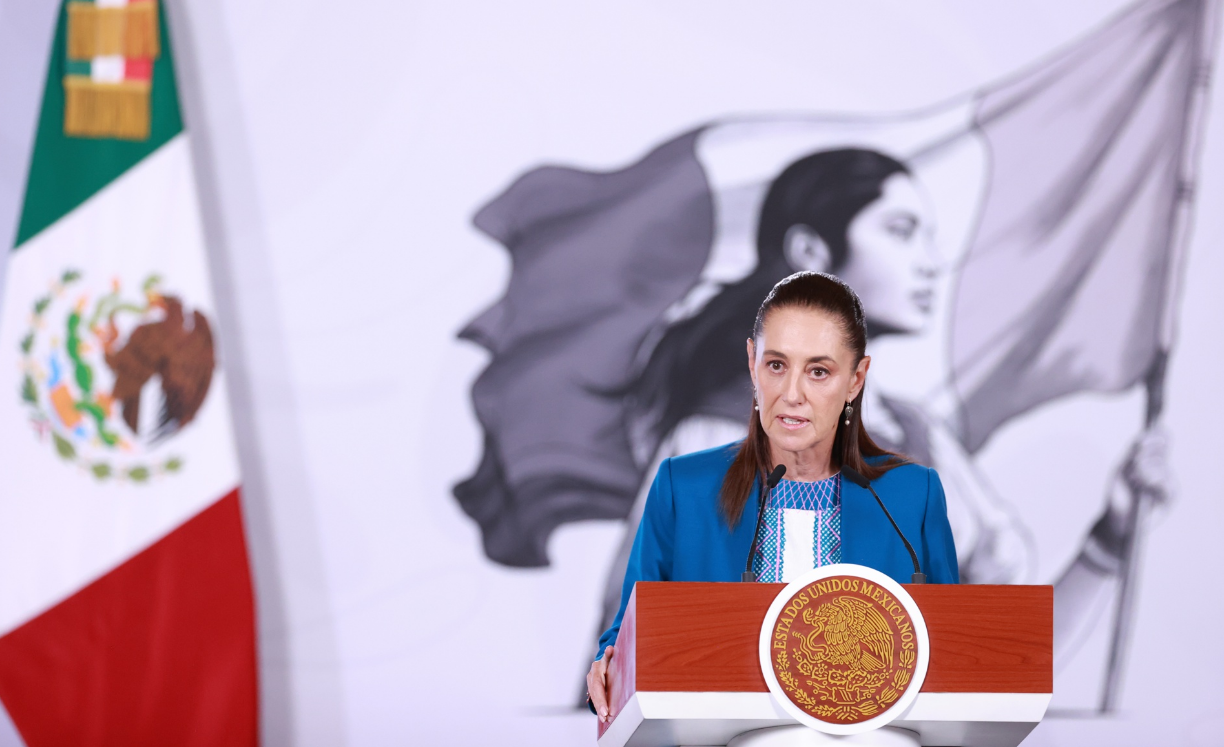
Sheinbaum’s impact and vulnerabilities
The challenges Sheinbaum faces are not of her own making, but are at least as old as the transition to democracy in 2000, if not to the economic crisis of 1976, and are made more difficult by the aggressiveness of US President Donald Trump’s administration. Her predecessor, Manuel Andres Lopez Obrador (AMLO) addressed these challenges in an unsustainable populist process, emphasizing a “Fourth Transformation” of the country to increase social welfare and political inclusion guided by a nationalist mass movement (MORENA) and oil wealth. While popular in Mexico (he left office with a 60% approval rating) rather than resolve the challenges, his administration saddled the country with promises that cannot be sustainably financed, white elephant infrastructure projects, emerging environmental disasters and a return to the authoritarian political structures of the Partido Revolucionario Institucional – PRI (1928-2000). Sheinbaum has continued to build authoritarian political structures, but she has carefully proceeded to modify government policy to lay the groundwork for real and sustainable solutions to Mexico’s challenges.
Sheinbaum began her tenure with two strong advantages. Her approval ratings upon taking office were in the 78-80% range, reflecting both her success as Head of the Government of Mexico City and as AMLO’s handpicked successor. Perhaps most importantly, AMLO has not attempted to govern/pressure her to adhere strictly to his vision, unlike what Rafael Correa in Ecuador and Evo Morales in Bolivia did to their left wing successors (Lenin Moreno and Luis Alberto Arce, respectively) who sought to make the left wing projects sustainable.
These incredibly high approval ratings naturally fell over time, but the four major polling firms (El Financeiro, Buen Dia & Marquez, Enkoll and AtlasIntel) still record high ratings for her as President in May 2026 (60 to 68%), indicating her strong personal connection with citizens. Her highest approval ratings come in the area of social programs (71%), indicating the importance of sustainable financing for them. Regarding her leadership of the country in general, polls suggest lukewarm support with 48-50% approval. To understand those numbers we need to look specifically at crime, corruption, the economy and relations with the US.
AMLO’s approach to crime, including criminal gangs, was to emphasize the social origins of criminal behavior. This “hugs not bullets” approach produced increased crime in the short to medium term, however. Sheinbaum continued with the approach she used in Mexico City of strengthening the intelligence and investigative capacities of law enforcement and improving coordination between federal and state security forces to deter, apprehend and punish criminals. The result has been a significant drop in the daily number of murders registered in the country: -44% from the month before she assumed the Presidency (September 2024) to February 2026. High impact crimes also fell 28%. However, femicides, enforced disappearances (especially the 2014 unsolved case of students at Ayotzinapa which AMLO stalled) and a growing number of unidentified human remains generate disappointment and disapproval among significant Mexican communities, as well as casting doubt on the reliability of the decline in the murder rate. Sheinbaum’s dismissal of the UN Committee on Enforced Disappearances, CED report in April 2026 further undermines her government on these issues. The National Survey of Urban Public Safety (INEGI) of March 2026 reported that 61.5% of respondents perceived their city as unsafe, with the rate rising for females to 67.2%; worse yet, the quarterly trend in perceptions of insecurity rose between December 2025 and March 2026.
Read also: The Sheinbaum moment and Mexico’s opportunity
Bloomberg’s commissioned survey of May 2026 reported that 62% of respondents ranked corruption as the chief problem facing the country. Corruption is not simply a home-grown product in Mexico as the US-fueled drug trade and President Trump’s rhetoric amplify the issue. Nevertheless, it has long been an aspect of the Mexican political system and daily life. Sheinbaum has moved aggressively to weed out corruption, even among members of her government and political party. But she attempts to walk a fine line denouncing US government accusations about corruption within the Mexican government with nationalist fervor. But the US often has sufficient evidence and the Mexican people continue to believe that corruption exists even within the MORENA government. The debacle surrounding her initial pushback against Washington’s accusations of ties of the Sinaloa governor and other officials with a drug cartel undermines her efforts to fight corruption.
Sheinbaum is aware that Mexico’s economy needs to provide the wealth to support the Fourth Transformation project. Unfortunately, AMLO’s vision of oil wealth ignored the limits of the country’s oil reserves and the environmental damage increasing oil production and use would have; he also depended on salvaging US-Mexican trade integration. Sheinbaum understands the need to diversify away from oil and mitigate Mexico’s dependence on trade with the US. She has reversed AMLO’s rejection of solar and wind energy, is exploring the possibility of fracking in the natural gas rich north, and seeking foreign investment to develop innovative sectors within the Mexican economy. She recognizes the need for trade with the US and is pursuing renewal of the US-Mexico-Canada Agreement (USMCA, perhaps even without Canada) but she is also developing deeper trade ties with the European Union. In this regard, she backed down from AMLO’s demand that Spain apologize for the Conquest in 1521 and its violence. That demand had frozen relations when the King did not even reply to the demand. But Sheinbaum, the King and the Spanish government have come together around the recognition that ‘abuses’ were committed during the Colonial period.
When Trump claimed this past week that the U.S. will not renew the USMCA Sheinbaum immediately pointed out that the agreement will continue at least until 2036 and that negotiations will continue to fully extend it to 2042. As most world leaders have learned, Trump utilizes extreme threats as negotiating tactics and in the face of high costs for carrying out those threats accepted terms far below the extreme demand. Sheinbaum’s team is clearly cognizant of the domestic economic and political costs to the Trump administration of terminating the USMCA and the need to stay focused on the actual negotiations.
Of course, reorienting an economy as large as Mexico’s (12th largest in the world in 2024) for sustainable and efficient development is not an easy task. Sheinbaum has not given up on the goal of promoting growth and social justice, but she doesn’t control all the incentives that drive responses by investors, workers and consumers. Consequently, the fact that Mexico’s GDP grew by only 0.7% in 2025 and may grow 1.5% in 2026 is a serious issue for the country.
The Trump administration is the key external factor impacting how Mexico responds to its challenges. President Trump is focused on the short term, is erratic in behavior and policy, vengeful, and a high stakes gambler. Like it or not, Mexico is particularly vulnerable to the US. Sheinbaum, and AMLO before her, clearly understand the situation and choose to behave prudently in reacting to US provocations without ceding the right to be sovereign and to dissent. Emphasizing her government’s sovereign right to pursue its national interests, she has deployed troops to the border to discourage illegal crossing from Mexico to the US, increased the seizure of illicit drugs, extradited dozens of individuals facing warrants to the US, stopped shipping oil to Cuba, and begun USMCA renegotiations without Canada’s involvement.
It is not clear if these responses are sufficient to keep Trump at bay and maintain her nationalist credentials at home. The nightmare scenario would be Trump making use of his February 2025 designation of Mexican drug cartels as ‘foreign terrorist organizations’ (FTO) and using the Supreme Court-sanctioned right of the US government to kidnap foreign citizens for trial in the US to covertly operate in Mexico. Surveys indicate that currently only around 50% of Mexicans perceive that she is managing this key relationship well; such an action by Washington would leave Sheinbaum with no responses that could save her administration.
Looking ahead
AMLO left Sheinbaum a difficult legacy as she attempts to address Mexico’s challenges within a leftward and sustainable process. If she fails to adequately address these challenges Mexico is vulnerable to a wave of radical populism.
Read also: Petro’s reality check: Colombia is not that easy to change
These politicians build on the fact that traditional politicians and parties previously governed and failed. Populists of both the left and right preach the need to destroy the party system and dramatically empower the new president. On the left, Chavez sold this narrative to Venezuelans after two decades of party failure; on the right, Bukele convinced Salvadorans after both the former rebels (FMLN) and the conservative Nationalist parties failed.
In Mexico, the conservative right failed in two terms from 2000-2012, the centrist PRI failed in 2012-2018 and this would be the failure of the populist left from 2018-2030. The door would thus be open for radical right wing populism.