How the new generation is battling for democracy in Serbia, for collective memory in Bosnia
In the year that marks three decades since the outbreak of one of the most devastating conflicts in Europe since World War II, the Yugoslav wars of the 1990s, students in Serbia have blocked over 60 university faculties across the country (out of approximately 80), protesting against corruption and the increasingly authoritarian regime of President Aleksandar Vučić.
In recent months, Serbian students have continued their demonstrations, demanding justice for the 16 people killed when a train station collapsed in November, a tragedy widely attributed to government negligence and corruption. Frustrated by the lack of accountability, they have been calling for elections since May. The most recent protest, held in Belgrade on June 28, drew around 140,000 demonstrators and ended in clashes with the police, highlighting Vučić’s unwillingness to relinquish power through democratic means and the growing unlikelihood of free elections anytime soon.
The protest date coincided with Vidovdan (St. Vitus Day), a significant national and religious holiday commemorating the 1389 Battle of Kosovo and the death of Prince Lazar, an occasion deeply tied to Serbian identity, patriotism, and reflection.
The regime of Aleksandar Vučić is facing the longest protests in the modern history of Serbia, and probably the longest-lasting protests since Serbia became an independent State.
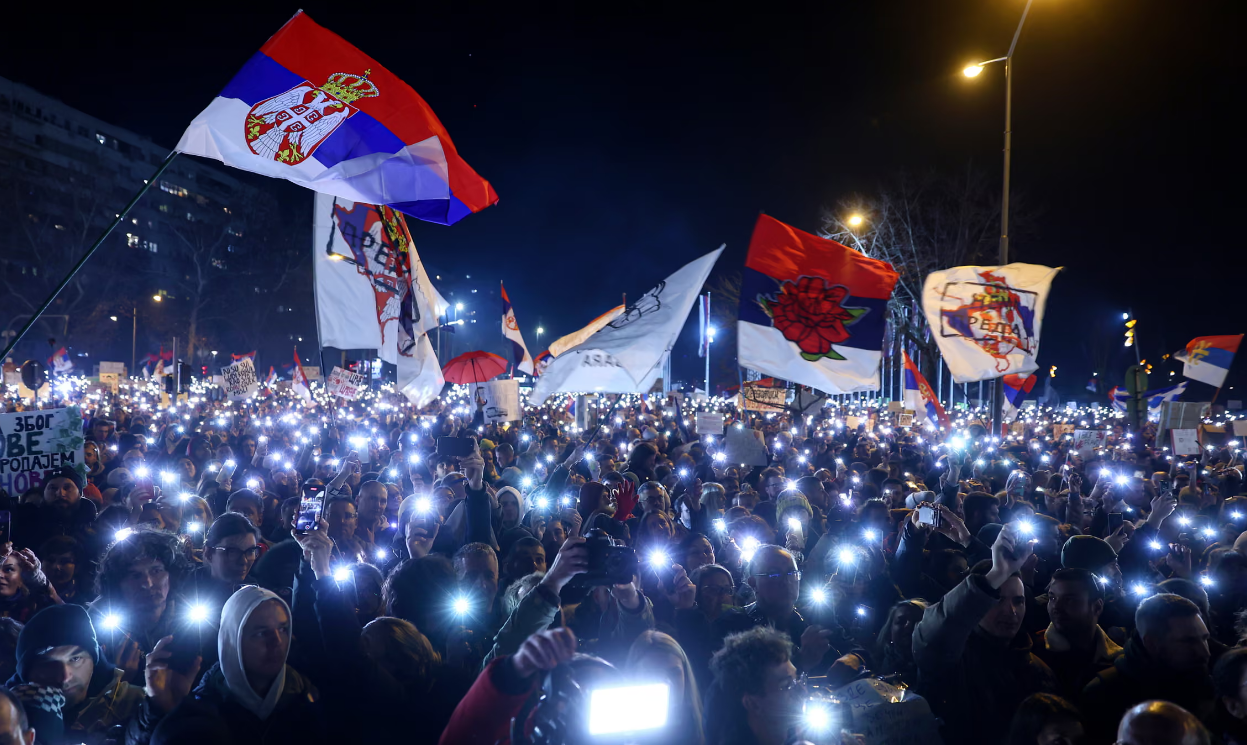
For eight and a half months, with almost undiminished ferocity, the citizens of Serbia have been trying to bring power back within the limits of the law. The protests by Serbian students, which have led to the occupation of more than 60 university faculties across the country, began on November 22nd. On that day, in front of the Faculty of Dramatic Arts in Belgrade, a group of individuals attacked students who had gathered to observe a 15-minute silence in memory of lives lost.
During the commemoration, the students were physically assaulted by individuals linked to the Serbian Progressive Party, the dominant political force backing President Aleksandar Vučić. As the police failed to intervene, the students responded by occupying the faculty, halting all academic activities. In the days that followed, students from Belgrade, Novi Sad, and other cities joined the protest, demanding accountability from the relevant institutions. Specifically, they called on authorities, especially the State Prosecutor, to prosecute those responsible for the attacks and to release documentation related to the reconstruction of the railway station.
The students also demanded transparency about how and where the 65 million euros allocated for the station’s reconstruction had been spent. The project had been awarded to a consortium of two Chinese companies: China Railway International and China Communications Construction.
More than eight months after the incident in Novi Sad, not all perpetrators have been identified. Two ministers have resigned one of whom was briefly arrested and then released. The Prime Minister also resigned, but only after the brutal beating of a female student by members of the Serbian Progressive Party, which left her with a broken jaw.
These events have fueled widespread mistrust toward the ruling party and the president. Students and citizens are now calling for early elections, which, according to recent polls, would likely lead to a change of government, provided the elections are free and fair.
While Serbian students are fighting for rights, truth, freedom, and democracy in the country they hope to continue living in, students in Bosnia and Herzegovina face a different challenge: uncovering the truth about the 1990s war and building a collective memory, key steps toward dialogue and reconciliation among the country’s divided communities.
In various parts of Bosnia and Herzegovina, students are taught different “truths”, or fragmented versions about the suffering and crimes committed during the war. The country remains deeply divided along the three ethnic/administrative lines. The country is structured into two main entities, the Federation of Bosnia and Herzegovina (primarily Bosniak and Croat) and Republika Srpska (primarily Serb), with a weaker central government.
Until 2018, the teaching of history became one of the most sensitive issues following the end of the war and the start of Bosnia’s reintegration process. At that time, it was officially agreed—or more precisely, imposed by the OSCE—that the history of the 1992–1995 war, in which 100,000 people were killed and over half the population of the former Yugoslav republic was displaced, would not be taught in schools, aside from general information about its beginning and end. This embargo remained in effect until 2018.
Since then, each ethnic group, Serbs, Bosniaks, and Croats, has implemented its own history curriculum, presenting crimes, victims, and perpetrators differently. In one school in Busovača, central Bosnia, a so-called “two schools under one roof” system exists, where students are not only taught different curricula but are physically separated. The school is attended by 240 students of Bosniak and Croat ethnicity, but they attend in separate shifts. Each group observes its own national and religious holidays though students often show little interest in these distinctions.
The depth of historical division is underscored by the fact that history textbooks do not even agree on when the war started. Each ethnic group cites a different date, sometimes differing by months, sometimes by years.
In a ninth-grade history textbook authored by Dragiša Vasić, a professor at the Faculty of Philosophy in Banja Luka (the capital of Republika Srpska, the Bosnian Serb entity), figures such as Ratko Mladić and Radovan Karadžić are presented as key military and political leaders. The textbook, officially introduced in Republika Srpska in September 2024, describes Karadžić, former president of Republika Srpska, as a poet, psychiatrist, and politician who helped establish the Serb entity. It omits any mention of his life sentence for genocide and crimes against humanity, handed down by the International Criminal Tribunal for the former Yugoslavia (ICTY) in 2019. It simply states that he was transferred to the tribunal.
Ratko Mladić, former commander of the Army of Republika Srpska, is depicted as a general who defended Serbs in Croatia and played a major role in the creation of Republika Srpska. Although the textbook notes his extradition to The Hague in 2011, it does not explain why. He was sentenced to life imprisonment for genocide in Srebrenica, where over 8,000 Bosniak men and boys were murdered in July 1995, and for war crimes committed across Bosnia.
There is no mention in Vasić’s textbook of the Srebrenica genocide, its victims, or the suffering of any people besides the Serbs.
The war’s end in 1995 is narrated primarily through the Serbian lens highlighting the capture of Srebrenica and Žepa, the fall of the Republic of Serbian Krajina, the expulsion of 250,000 Serbs from Croatia, and the signing of the Dayton Agreement. The suffering of other ethnic groups is omitted.
The conflict in Bosnia and Herzegovina formally ended with the Dayton Agreement of November 1995, which divided the country into two entities: the Federation of Bosnia and Herzegovina and Republika Srpska.
Conversely, textbooks used in the Federation are also criticized for biased narratives and omissions. A supplementary ninth-grade textbook introduced in Tuzla Canton in 2022, authored by Sarajevo professors Almir Bećirović and Nazim Ibrahimović, dedicates 64 pages to the breakup of Yugoslavia, the Bosnian War, war crimes, and the destruction of cultural heritage. It presents the war predominantly through the lens of Bosniak victimhood, omitting the suffering of other ethnic groups and the crimes committed by the Bosnian Army, which were documented and prosecuted by the ICTY and Bosnia’s state court.
In January 2024, the Constitutional Court of Bosnia and Herzegovina annulled part of the Republika Srpska curriculum titled “Topic 11: Republika Srpska and the Defensive-Homeland War” following complaints about the glorification of war criminals. Nevertheless, the textbook remains in use in Republika Srpska schools.
According to Džana Brkanić, deputy editor-in-chief of the Balkan Investigative Reporting Network (BIRN), analyzes show that primary school history textbooks in Bosnia and Herzegovina present three conflicting versions of recent history often filled with factual inaccuracies.
“We can’t claim history is taught better in one part of the country than another,” Brkanić said, “but it’s clear that what students learn is politically shaped and reflects the dominant narratives of their respective ethnic communities.”
Between April 2021 and March 2023, BIRN created a database of judicially established facts, using ICTY verdicts to extract and adapt facts for educational use. They also prepared multimedia materials, excluding graphic images but preserving firsthand testimonies from war survivors and witnesses of specific crimes.
BIRN offered these materials to all ministries of education in the cantons of the Federation of Bosnia and Herzegovina, as well as to the Ministry of Education of Republika Srpska. Only Sarajevo and Tuzla Canton ministries signed memorandums and included the database as supplementary teaching material.
BIRN never received a response from the Republika Srpska ministry.
“In Sarajevo and Tuzla, we were invited as journalists to speak directly to students. However, we believe the work must begin with teachers, many of whom experienced the war firsthand. For some, it remains too painful to discuss let alone teach,” said Brkanić.
Later, historian Melisa Forić-Plasto from the Faculty of Philosophy in Sarajevo adapted the material for classroom use.
Professor Nerma Halilović Kibrić, from the Faculty of Criminal Justice, Criminology, and Security Studies in Sarajevo, observes that most young people do not form independent views about the past.
“Their perspectives are largely inherited from the previous generation, mostly from their parents,” she said.
In 2016 and 2017, she conducted research with students from the three largest universities, Sarajevo, Mostar, and Banja Luka, revealing deep distrust among the country’s ethnic groups. “In the kind of society we live in today, education should promote dialogue, but in Bosnia and Herzegovina, it often does the opposite,” she said.
Still, there are young people and students in Bosnia, like Nia Abadžić from the University of Sarajevo, who believe that only a shared memory and acceptance of historical truths can pave the way toward dialogue and a more united future. “If we had a unified education system in Bosnia, only then could we begin to build a path toward dialogue and mutual trust,” Abadžić stated.
Read also: Don’t forget the Balkans
The notion that new generations, those born after the war in Bosnia and Serbia, are apolitical and uninterested in social issues has been dispelled by recent events in Serbia. There, students reignited civic activism after more than a decade of political apathy, rising up against a leader who equates himself with the state. This is not a “color revolution,” but a movement of ordinary people demanding change and the respect of their fundamental human and democratic rights.
Inspired by these protests, students in Bosnia and across the region have voiced solidarity with their peers in Belgrade and other Serbian cities, encouraging them to persevere in their struggle for a better future.